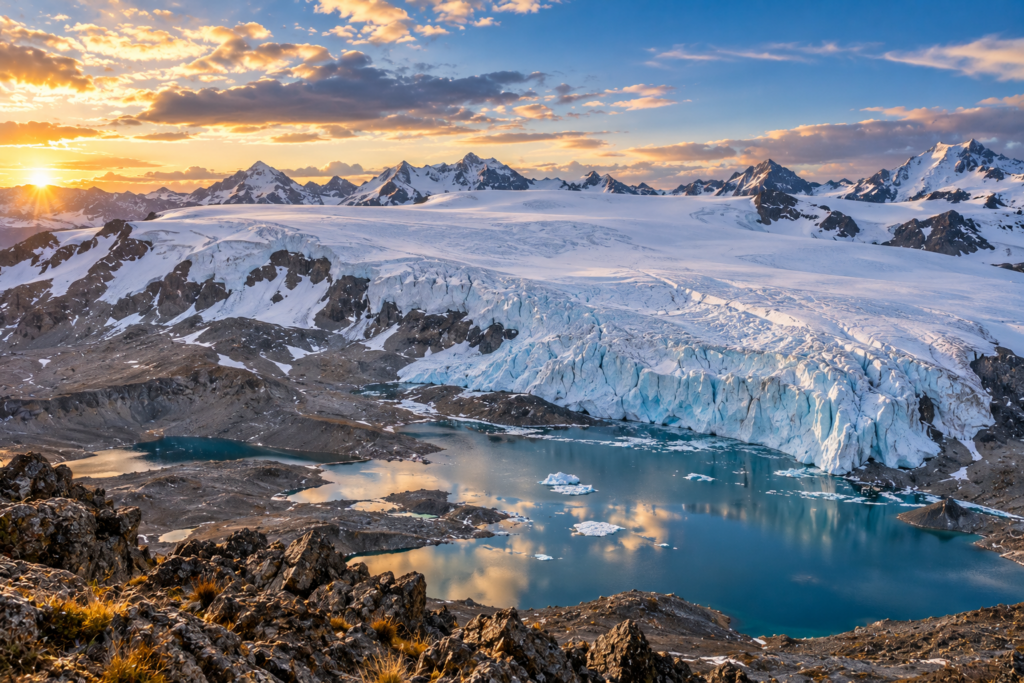
High in the Peruvian Andes sits the Quelccaya Ice Cap, one of the world's best-known tropical ice masses.
For decades, scientists have documented its retreat.
The photographs are striking. The measurements are clear. The ice cap has lost a substantial portion of its area.
But in 2001, the retreat acquired something more specific:
An expiration date.
Between 2010 and 2020, according to an estimate discussed by glaciologist Lonnie Thompson.
2020 came and went.
Quelccaya did not disappear.
And unlike many historical predictions whose outcomes are difficult to reconstruct, this one can now be compared with a modern peer-reviewed measurement.
In 2022, approximately 36.7 square kilometers of the ice cap remained.
The retreat was severe.
The predicted disappearance was not observed.
The 2001 Prediction
The prediction came from the same 2001 Living on Earth interview that produced the famous Kilimanjaro 2015 statement.
Lonnie Thompson discussed the rapid retreat of tropical glaciers and turned to Quelccaya.
His estimate was conditional.
If the observed retreat rate continued, Quelccaya's estimated demise would occur sometime between:
2010 and 2020.
Those words matter.
IF THE CURRENT RATE CONTINUES
This was not a claim that some immutable physical law guaranteed the ice cap would cease to exist by December 31, 2020.
It was an extrapolation.
But extrapolations with dates can be tested.
And this one now can be.
Why Quelccaya Mattered
Quelccaya is scientifically important for reasons extending far beyond its size.
Tropical ice preserves records of past atmospheric conditions.
Ice cores extracted from these high-altitude glaciers can provide researchers with information about precipitation, dust, chemistry and climate extending far into the past.
The retreat of Quelccaya was therefore not merely a picturesque example of melting ice.
It represented the transformation of an important natural archive.
Researchers had measured that retreat for years.
The question was not whether the ice cap was changing.
It plainly was.
The test was narrower:
Would the observed rate carry Quelccaya all the way to disappearance by 2010–2020?
The Problem With Drawing a Line to Zero
Imagine an ice cap shrinking rapidly.
Measure its area at one date.
Measure it again years later.
Calculate the rate of decline.
Then extend that rate forward until the line reaches zero.
The result produces a date.
Mathematically, the process is straightforward.
Physically, glaciers are not.
As a glacier retreats, the object being measured changes.
Its geometry changes.
The surviving ice occupies different terrain.
Elevation can change.
Accumulation zones can change.
Debris and shading can matter.
Precipitation and temperature vary.
And the relationship between surface area and total ice volume is not constant.
That means:
PAST RATE OF LOSS ≠ GUARANTEED FUTURE RATE OF LOSS
A linear extrapolation can be scientifically informative without becoming a reliable expiration date.
Your book makes precisely this distinction: a linear extrapolation is not somehow fraudulent because the subsequent rate changes. But once an extrapolated zero date enters public discussion, the calendar gives us a straightforward opportunity to test it.
2010 Arrived
The beginning of the predicted disappearance window arrived.
Quelccaya remained.
That alone did not invalidate the full estimate because the window extended through 2020.
There were still ten years to go.
And the ice continued retreating.
Then 2020 Arrived
The end of the window arrived.
Quelccaya still existed.
The crucial question then became quantitative.
How much remained?
Fortunately, subsequent researchers answered it.
The Measurement After the Deadline
A 2024 study published in The Cryosphere reconstructed the recent evolution of the Quelccaya Ice Cap.
Importantly, Thompson himself was among the study's coauthors.
The researchers found that Quelccaya's area had declined from approximately:
58.7 km² in 1985
to approximately:
36.7 km² in 2022.
That represents roughly a 37 percent reduction in area.
It is substantial.
It is consequential.
It is evidence of major retreat.
It is also nowhere close to zero.
36.7 Square Kilometers Is Not a Technicality
When a prediction says an ice cap will disappear, survival is not a semantic loophole.
Approximately 36.7 square kilometers is a substantial remaining ice area.
The distinction between “smaller” and “gone” is therefore fundamental.
Suppose someone predicts that a reservoir will be empty by 2020.
By 2022, the reservoir has lost 37 percent of its surface area but still contains a large body of water.
It would be misleading to say nothing happened.
It would be equally misleading to say the empty-reservoir prediction came true.
Quelccaya requires the same discipline.
SUBSTANTIAL LOSS ≠ DISAPPEARANCE
The Prediction Was Conditional
There is nevertheless an important difference between this case and a categorical declaration.
The original estimate contained a condition:
If the current retreat rate continued.
That condition must remain attached to the prediction.
If the rate changed, the premise underlying the extrapolation changed.
That means the fairest verdict is not:
“Scientists falsely claimed with certainty that Quelccaya would vanish.”
The source does not support that formulation.
The accurate reconstruction is:
A scientist observed rapid retreat and estimated that, if the contemporary rate continued, the ice cap's demise would occur between 2010 and 2020.
The rate did not carry the ice cap to zero.
That is exactly why preserving the original wording matters.
Kilimanjaro and Quelccaya Tell Similar — But Not Identical — Stories
The two cases appeared in the same 2001 interview.
Yet they should not simply be merged into one claim.
For Kilimanjaro, Thompson gave the striking direct statement:
“The ice will disappear by 2015.”
The subsequent Science paper presented a more conditional 2015–2020 projection.
For Quelccaya, the estimate was explicitly tied to continuation of the observed retreat rate.
Both deadlines were missed.
But the degree of certainty communicated was different.
This is one reason CLIMATE: THE PREDICTIONS THAT EXPIRED audits individual claims rather than treating every climate prediction as interchangeable.
WORDING MATTERS.
CONDITIONS MATTER.
DEADLINES MATTER.
A Failed Deadline Does Not Reverse the Trend
Quelccaya also demonstrates why “failed prediction” must not be confused with “nothing happened.”
The ice cap lost approximately 22 square kilometers between the 1985 and 2022 measurements cited in the later research.
That is an enormous physical change.
The retreat is observable.
It is measurable.
It is documented in peer-reviewed literature.
Nothing about the failed 2010–2020 disappearance window reverses those observations.
But those observations do not reverse the calendar either.
The predicted disappearance window ended.
Quelccaya remained.
Both facts belong in the same account.
Why This Distinction Matters
Public debates frequently force these cases into two incompatible stories.
One says:
“The prediction failed, therefore the underlying climate problem was false.”
The other says:
“The underlying trend was real, therefore the prediction did not really fail.”
Neither follows logically.
A trend and a deadline test different propositions.
A scientist can correctly identify the direction of change and incorrectly estimate its timing.
That happens in many scientific disciplines.
What matters is whether the error remains visible after the deadline.
A prediction that can only be declared correct, never incorrect, is not being tested.
Prediction Versus Observation
The Quelccaya case can be reduced to a simple audit trail:
1985 MEASURED AREA
Approximately 58.7 km².
↓
OBSERVED RETREAT
The ice cap is shrinking.
↓
2001 ESTIMATE
If the current retreat rate continues, estimated demise between 2010 and 2020.
↓
2010
Quelccaya remains.
↓
2020
Quelccaya remains.
↓
2022 MEASUREMENT
Approximately 36.7 km² remains.
↓
RESULT
Major retreat — but nowhere near disappearance.
The prediction and the observation can therefore be evaluated separately.
The Verdict
LOCATION: Peruvian Andes.
SUBJECT: Quelccaya Ice Cap.
CLAIM: If the contemporary retreat rate continued, its estimated demise would occur sometime between 2010 and 2020.
DEADLINE: 2010–2020.
1985 AREA: Approximately 58.7 km².
2022 AREA: Approximately 36.7 km².
OBSERVED CHANGE: Roughly 37 percent loss of area between those measurements.
OBSERVED OUTCOME: The ice cap remained well beyond the predicted disappearance window.
VERDICT: SUBSTANTIAL RETREAT CONFIRMED — DISAPPEARANCE BETWEEN 2010 AND 2020 NOT OBSERVED.
The important result is not that the scientist saw no change.
He saw a very real change.
The mistake was extending that change to zero too quickly.
THE ICE CAP SHRANK.
THE RATE CHANGED.
THE ZERO DATE FAILED.
From the Book
This article is adapted from the investigation presented in Patrick Panteix's CLIMATE: THE PREDICTIONS THAT EXPIRED — What We Were Told. What Actually Happened. Who Profited.
The book audits climate and environmental predictions by returning to original sources, preserving conditions and uncertainty, identifying deadlines, and comparing the claims with observations after those deadlines.
100 predictions. 100 verdicts.
SOURCES
Living on Earth — “Melting Snow Caps” / Interview with Lonnie Thompson (February 23, 2001)
In this contemporary interview, glaciologist Lonnie Thompson discussed the rapid retreat of Peru’s Quelccaya Ice Cap and estimated its demise sometime between 2010 and 2020 if the observed retreat rate continued.
https://www.loe.org/shows/shows.html?programID=01-P13-00008
Perry, L.B. et al. — “The state of the climate and cryosphere of the tropical Andes: the Quelccaya Ice Cap, Peru” (The Cryosphere, 2024)
Peer-reviewed post-deadline scientific assessment reconstructing the evolution of the Quelccaya Ice Cap. The study shows that the ice cap remained extensive after 2020 despite major long-term retreat.
https://tc.copernicus.org/articles/18/3069/2024/
DOI — The Cryosphere
https://doi.org/10.5194/tc-18-3069-2024
The Cryosphere — Supplementary Material
Data and supplementary information associated with the 2024 Quelccaya Ice Cap study.
https://tc.copernicus.org/articles/18/3069/2024/tc-18-3069-2024-supplement.zip
Ohio State University — Byrd Polar and Climate Research Center
Research center associated with decades of ice-core and glacier research on the Quelccaya Ice Cap led by Lonnie Thompson and colleagues.
https://byrd.osu.edu/