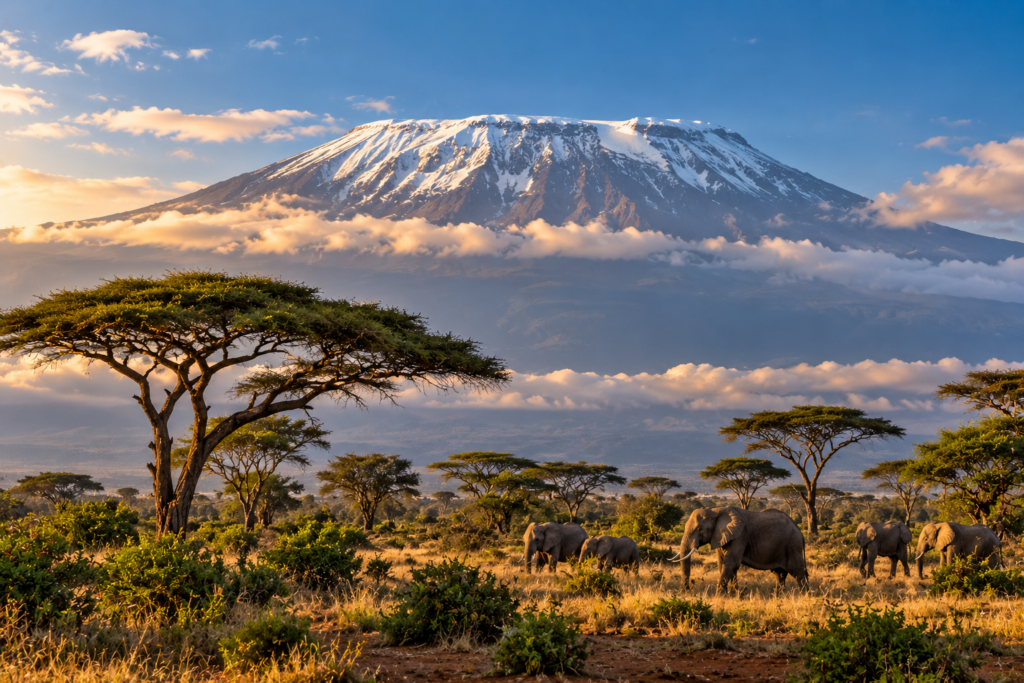
Mount Kilimanjaro is one of the most recognizable mountains on Earth.
Rising above the plains of Tanzania, only a few degrees south of the equator, its white summit became one of the defining visual symbols of climate change.
The reason was easy to understand.
The ice was shrinking.
Photographs taken decades apart showed a dramatic transformation.
And eventually, that retreat acquired something even more powerful than an image:
A deadline.
Then 2020.
Those dates have passed.
Kilimanjaro still has ice.
But that does not mean the original scientific story was imaginary. The mountain has experienced extraordinary ice loss.
Once again, two things can be true simultaneously:
THE RETREAT WAS REAL.
THE DISAPPEARANCE DEADLINE FAILED.
The 2001 Prediction
In 2001, glaciologist Lonnie Thompson of Ohio State University appeared on the environmental radio program Living on Earth.
He was asked when Kilimanjaro would be completely without its famous ice.
His answer was remarkably direct:
“For Kilimanjaro, the ice will disappear by 2015.”
Unlike predictions with distant end-of-century horizons, this one would not require generations to test.
The deadline was only fourteen years away.
And the statement was not a newspaper headline paraphrasing a scientist.
It came directly from the scientist himself.
Then Came the Scientific Paper
The following year, Thompson and his coauthors published research in Science examining Kilimanjaro's tropical ice fields.
The historical loss they documented was dramatic.
Approximately 80 percent of the mountain's twentieth-century ice area had disappeared.
That observation was real.
But the paper's forward-looking language was more careful than the 2001 interview.
It stated that if current climatological conditions persisted, the remaining ice fields were likely to disappear between approximately 2015 and 2020.
Those first words are essential:
IF CURRENT CLIMATOLOGICAL CONDITIONS PERSIST
This was a conditional projection.
It was not identical to saying:
THE ICE WILL DEFINITELY BE GONE BY 2020.
Yet the condition was much harder to remember than the date.
And the date became the story.
How a Conditional Projection Becomes a Countdown
The transformation is simple.
Researchers measure a strong decline.
They estimate what could happen if the observed conditions continue.
The result produces a possible date.
That date is repeated in interviews, documentaries, speeches and news coverage.
Eventually, the condition disappears.
What remains is:
KILIMANJARO — NO ICE BY 2020.
This is one of the recurring patterns examined throughout CLIMATE: THE PREDICTIONS THAT EXPIRED.
The original source may contain uncertainty.
The public version often contains a calendar.
The Image Was Irresistible
Kilimanjaro was uniquely suited to climate communication.
A graph showing changes in global temperature requires explanation.
A photograph of a tropical mountain losing its white summit does not.
Old photographs showed extensive ice.
New photographs showed much less.
The visual comparison was powerful because the underlying retreat was unmistakable.
But photographs cannot establish an exact disappearance date.
They can show:
THEN → MORE ICE
NOW → LESS ICE
They cannot, by themselves, prove:
FUTURE DATE → ZERO ICE
That requires an extrapolation.
And extrapolations have assumptions.
2015 Arrived
The first deadline arrived.
Kilimanjaro still had ice.
The direct 2001 statement — “the ice will disappear by 2015” — had not occurred.
But the scientific paper had provided a broader conditional window extending to approximately 2020.
So the test was not finished.
Five more years remained.
Then 2020 Arrived
The second deadline passed.
Kilimanjaro still had ice.
Again, this did not mean the mountain had somehow recovered its historical glaciers.
Far from it.
The surviving ice represented only a fraction of the historical coverage.
But a fraction is not zero.
The predicted disappearance had not occurred within the stated window.
What Did Researchers Find After the Deadline?
This is where the case becomes especially useful.
We do not have to rely on photographs from tourists or arguments on social media.
A peer-reviewed remote-sensing study published in 2024 measured the remaining tropical glacier area on Kilimanjaro.
For 2021–2022, researchers measured approximately:
0.98 square kilometers of glacier area remaining.
That is extremely little compared with Kilimanjaro's historical ice cover.
It confirms the severity of the retreat.
But mathematically and physically:
0.98 km² ≠ 0 km²
The distinction sounds almost absurdly simple.
Yet it is exactly the distinction required to audit the prediction.
Did the Prediction Completely Fail?
That depends on what is being tested.
If the proposition is:
“Kilimanjaro is losing its ice.”
The evidence strongly supports it.
If the proposition is:
“Kilimanjaro lost approximately 80 percent of its twentieth-century ice area.”
That historical finding was reported by Thompson and his colleagues.
If the proposition is:
“Kilimanjaro's remaining ice will disappear by 2015.”
That did not happen.
If the proposition is the more cautious:
“If current climatological conditions persist, the remaining ice fields are likely to disappear between 2015 and 2020.”
The predicted zero date still did not occur within that window.
The conditional wording must be preserved.
So must the outcome.
Why Zero Is Difficult to Predict
A glacier does not necessarily retreat toward zero at a constant rate.
As ice disappears, the physical system changes.
The remaining ice may occupy different elevations.
Its geometry changes.
Its exposure to sunlight changes.
Precipitation varies.
Snow accumulation varies.
Local atmospheric conditions matter.
And area, thickness and volume are not interchangeable measurements.
A rapid early decline therefore does not guarantee that the final remnant will disappear at the same rate.
This is why extrapolating a historical loss curve all the way to zero can produce a compelling date without producing an accurate date.
MEASURED RETREAT ≠ CONSTANT FUTURE RATE
CONSTANT FUTURE RATE ≠ CERTAIN ZERO DATE
The closer a forecast gets to “nothing remains,” the more sensitive that date can become to assumptions.
The Climate Story Is More Complicated Than Temperature Alone
Kilimanjaro also illustrates another important scientific point.
Tropical glacier change cannot always be reduced to a single variable.
Temperature matters, but so can precipitation, atmospheric moisture, cloud cover, solar radiation and sublimation.
The mechanisms governing a tropical summit are not necessarily identical to those governing a large mid-latitude valley glacier.
That complexity does not make the ice loss unreal.
It makes exact disappearance dates harder to predict.
What Should We Learn From the Missed Deadline?
The wrong lesson would be:
Kilimanjaro still has ice, therefore climate change is false.
The observations do not support that conclusion.
The mountain has undergone dramatic ice loss.
Another wrong lesson would be:
The ice declined dramatically, therefore the 2015–2020 prediction was correct.
The observations do not support that conclusion either.
A prediction containing a deadline must be evaluated against its deadline.
Otherwise, predictions become impossible to falsify.
If the date arrives and the event occurs, the prediction is celebrated.
If the date arrives and the event does not occur, the underlying trend is substituted for the original claim.
That is not a fair test.
Prediction Versus Observation
The Kilimanjaro record can therefore be reconstructed simply.
OBSERVATION
Large twentieth-century ice loss.
↓
2001 INTERVIEW
“The ice will disappear by 2015.”
↓
2002 SCIENTIFIC PAPER
If current climatological conditions persist, remaining ice likely disappears between 2015 and 2020.
↓
2015
Ice remains.
↓
2020
Ice remains.
↓
2021–2022 MEASUREMENT
Approximately 0.98 km² remains.
The historical retreat survived the test.
The zero date did not.
The Verdict
LOCATION: Mount Kilimanjaro, Tanzania.
OBSERVED HISTORICAL CHANGE: Approximately 80 percent loss of twentieth-century ice area reported in the 2002 study.
2001 CLAIM: “For Kilimanjaro, the ice will disappear by 2015.”
SCIENTIFIC PROJECTION: If then-current climatological conditions persisted, remaining ice fields were likely to disappear between 2015 and 2020.
DEADLINE: 2015–2020.
OBSERVED AFTER DEADLINE: Approximately 0.98 km² of glacier area remained in 2021–2022 according to a peer-reviewed 2024 remote-sensing study.
VERDICT: MAJOR RETREAT CONFIRMED — COMPLETE DISAPPEARANCE BY 2015–2020 NOT OBSERVED.
Kilimanjaro does not demonstrate that glacier loss was invented.
It demonstrates something more useful.
A real physical trend can be dramatic.
A projection can have a legitimate scientific basis.
A conditional extrapolation can be reasonable when it is made.
And the resulting deadline can still be wrong.
THE ICE RETREATED.
THE ICE REMAINED.
THE DEADLINE EXPIRED.
From the Book
This article is adapted from the investigation presented in Patrick Panteix's CLIMATE: THE PREDICTIONS THAT EXPIRED — What We Were Told. What Actually Happened. Who Profited.
The book audits climate and environmental predictions by returning to the original source, identifying the exact wording and conditions, establishing the deadline, and comparing the claim with observations after that deadline.
100 predictions. 100 verdicts.
SOURCES
Living on Earth — “Melting Snow Caps” / Interview with Lonnie Thompson (February 23, 2001)
In this contemporary interview, Thompson was asked when Kilimanjaro would be completely without snow or ice. He answered: “For Kilimanjaro, the ice will disappear by 2015.”
https://www.loe.org/shows/shows.html?programID=01-P13-00008
Thompson, L.G. et al. — “Kilimanjaro Ice Core Records: Evidence of Holocene Climate Change in Tropical Africa” (Science, 2002)
The peer-reviewed paper reported that Kilimanjaro’s ice fields had lost about 80% of their twentieth-century area and stated that, if current climatological conditions persisted, the remaining ice fields were likely to disappear between 2015 and 2020.
https://pubmed.ncbi.nlm.nih.gov/12386332/
DOI — Science
https://doi.org/10.1126/science.1073198
U.S. Geological Survey — “The Glaciers of Kilimanjaro”
USGS historical and satellite overview of Kilimanjaro’s glacier retreat. It notes Thompson’s early warning that the glaciers might disappear between 2015 and 2020 and documents the long-term retreat of the mountain’s ice.
https://eros.usgs.gov/earthshots/the-glaciers-of-kilimanjaro
Hinzmann, A. et al. — “Tropical glacier loss in East Africa: recent areal extents on Kilimanjaro, Mount Kenya, and in the Rwenzori Range from high-resolution remote sensing data” (Environmental Research: Climate, 2024)
Using high-resolution satellite imagery from 2021/2022, the researchers measured approximately 0.98 km² of glacier ice still remaining on Kilimanjaro after the 2015–2020 disappearance deadline.
https://doi.org/10.1088/2752-5295/ad1fd7
PANGAEA — Glacier Extent Dataset for Kilimanjaro, Mount Kenya and the Rwenzori Range (2021/2022)
Underlying scientific dataset associated with the 2024 study.
https://doi.org/10.1594/PANGAEA.963210