
Most of the World’s Great Coral Reefs Were Supposed to Be Gone by 2020 — What Happened?
Text to paste into WordPress
Coral reefs have become one of the most powerful symbols of environmental decline.
The images are difficult to forget.
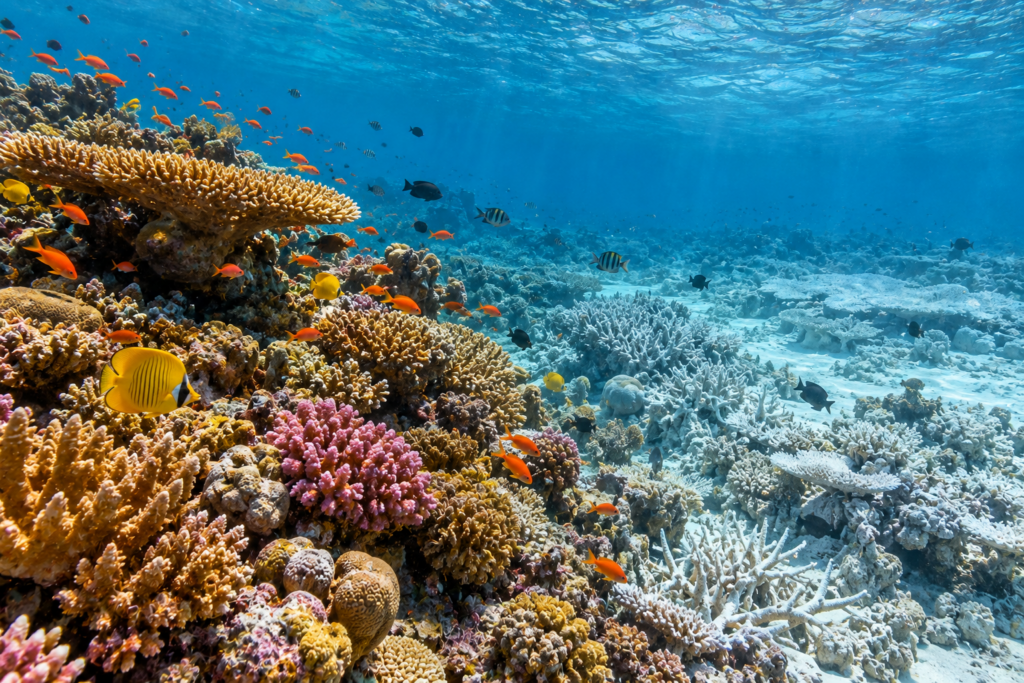
A healthy reef can be crowded with color and life. After severe bleaching, the same landscape can appear pale, damaged and almost empty.
The threats are real.
Ocean warming can trigger mass coral bleaching. Pollution, destructive fishing, coastal development, disease and ocean acidification can add further pressure. Some reefs have suffered devastating losses.
But at the beginning of the twenty-first century, the warning became much more specific.
It acquired a deadline:
2020.
Most of the world's great coral reefs, the public was told, could be gone by then.
2020 arrived.
The world's coral reefs were in serious trouble.
But most of them were not gone.
That distinction is the subject of this audit.
The Prediction
The prediction examined in CLIMATE: THE PREDICTIONS THAT EXPIRED is associated with Rowan Sage and a warning that most of the world's great coral reefs were likely to be gone by 2020.
This was not an open-ended statement that reefs might deteriorate sometime in the distant future.
It contained a testable horizon.
By 2020.
That changes the question.
We are not asking whether coral reefs were threatened.
They were.
We are not asking whether major coral loss occurred.
It did.
We are asking something narrower:
By 2020, were most of the world's great coral reefs gone?
The post-deadline evidence does not support that proposition.
What Does “Gone” Mean?
This is the first difficulty in auditing a prediction about coral reefs.
A reef is not a single organism.
It is an ecosystem and a physical structure containing many coral colonies and many other species.
A reef can lose coral cover without physically disappearing.
It can experience bleaching without every coral dying.
It can suffer mortality while retaining surviving coral.
It can shift in species composition.
It can become severely degraded and still remain identifiable as a coral-reef ecosystem.
Those distinctions matter.
BLEACHING ≠ DEATH
CORAL MORTALITY ≠ TOTAL CORAL LOSS
CORAL LOSS ≠ REEF DISAPPEARANCE
SEVERE DEGRADATION ≠ “GONE”
Without those distinctions, almost any negative change could retrospectively be treated as fulfillment of a prediction that reefs would disappear.
That would make the original wording impossible to test.
What Is Coral Bleaching?
Corals live in a close relationship with microscopic algae that provide much of their energy and give many corals their color.
Under stressful conditions — particularly unusually warm water — corals can expel these algae.
The coral becomes pale or white.
It has bleached.
A bleached coral is under serious stress.
But bleaching is not automatically death.
If stressful conditions subside soon enough, some corals can recover.
If the stress is severe or prolonged, substantial mortality can occur.
This is why photographs of a white reef are powerful evidence of stress but are not, by themselves, proof that the entire reef has permanently disappeared.
The World's Reefs Really Were Being Damaged
Nothing about the failed 2020 deadline means the warnings surrounding coral reefs were invented.
Global monitoring has documented serious reef deterioration.
Mass bleaching events have affected reefs across multiple ocean basins.
Local pressures compound the effects of marine heat.
Some individual reefs and regions have experienced major reductions in living coral cover.
The scientific concern was therefore based on a real phenomenon.
This is important because the easiest way to mishandle an expired prediction is to replace one exaggeration with another.
The claim:
“Most great coral reefs were not gone by 2020.”
does not logically imply:
“Coral reefs were fine.”
They were not.
The 2020 Test
The Global Coral Reef Monitoring Network provides a particularly useful post-deadline reference.
Its global assessment documented substantial losses of hard coral during periods of severe disturbance.
But it also documented something incompatible with the ordinary meaning of “most of the world's great coral reefs are gone”:
extensive coral reefs still existed after 2020.
They were being measured.
Their coral cover was being compared.
Some had declined.
Some had recovered to varying degrees.
Some regions performed differently from others.
The world's reefs had not become a historical ecosystem that researchers could only study in photographs.
The deadline had passed.
The reefs remained.
A Global Average Can Hide Very Different Stories
Coral reefs also demonstrate why environmental predictions are difficult to reduce to one global number.
The Great Barrier Reef is not identical to reefs in the Caribbean.
Reefs in the Indian Ocean do not necessarily experience the same sequence of disturbances as reefs in the Pacific.
One region may experience catastrophic coral mortality while another retains substantially higher coral cover.
Even within a single reef system, one area may be devastated while another survives.
And conditions can change again a few years later.
That means a statement about most of the world's great coral reefs is an extraordinarily broad claim.
It requires global evidence.
A photograph of one devastated reef cannot prove it.
Neither can a photograph of one spectacular healthy reef disprove the broader environmental threat.
The Great Barrier Reef Shows Why Snapshots Can Mislead
Australia's Great Barrier Reef illustrates this problem particularly well.
It has experienced repeated mass bleaching events.
Those events are serious.
Yet measured hard-coral cover can also rise substantially during periods between major disturbances, depending on region and coral composition.
A photograph taken after a severe bleaching event and a photograph taken during a period of recovery could therefore tell dramatically different stories about the same reef system.
Neither photograph is necessarily false.
Neither is sufficient on its own.
Environmental auditing requires time series, definitions and consistent metrics.
ONE IMAGE ≠ A GLOBAL TREND
ONE YEAR ≠ A PERMANENT STATE
Then Came More Global Bleaching
The expiration of the 2020 prediction did not end the danger.
In the years after the deadline, marine heat continued to place enormous pressure on coral reefs.
Another global coral bleaching event was subsequently documented.
This is precisely why the verdict must remain narrow.
A failed deadline does not guarantee that the feared event can never occur later.
It tells us only that the predicted outcome did not occur by the stated date.
That is the same rule applied throughout this investigation.
If someone predicts that an event will occur by 2020 and it occurs in 2035, the underlying concern may ultimately prove justified.
But the 2020 prediction was still wrong about timing.
Why Deadlines Matter
It can be tempting to dismiss timing as a minor detail.
It is not.
Timing influences decisions.
A prediction that something may happen over the next century communicates a different level of urgency from a prediction that it will happen within ten years.
Governments respond to timelines.
Businesses respond to timelines.
Voters respond to timelines.
Donors respond to timelines.
Investors respond to timelines.
News organizations build headlines around timelines.
And the public remembers them.
If the date can be emphasized before the deadline but ignored after it, the prediction has effectively become impossible to fail.
That is not how a meaningful forecast should be evaluated.
A Prediction Can Fail While the Warning Remains Important
The coral-reef case may be one of the clearest demonstrations of this principle.
Imagine only two possible verdicts:
A. The prediction failed, therefore coral reefs are safe.
or
B. Coral reefs remain threatened, therefore the prediction was correct.
Both are logically defective.
There is a third answer:
The deadline failed and the environmental threat remained serious.
That answer may be less satisfying politically or rhetorically.
It is much closer to the evidence.
The Difference Between Direction and Destination
The prediction contained two ideas.
First:
Coral reefs were deteriorating.
Second:
That deterioration would carry most of the world's great reefs to the point of being “gone” by 2020.
The first proposition can be supported while the second fails.
This is the same mathematical problem encountered in glacier predictions.
Observe a decline.
Measure its rate.
Project that rate forward.
Eventually the line reaches zero.
But ecosystems do not necessarily move toward zero at a constant rate.
There can be recovery.
There can be adaptation.
There can be regional differences.
There can be nonlinear responses.
New disturbances can accelerate decline.
Changing conditions can slow it.
TREND ≠ CONSTANT RATE
DECLINE ≠ ZERO
RISK ≠ DEADLINE
What Would Count as a Fair Verdict?
The prediction should be judged according to what it actually said.
If most of the world's great coral reefs had effectively disappeared by 2020, the prediction would deserve credit.
They had not.
If nothing significant had happened to coral reefs, the underlying warning would deserve rejection.
But that did not happen either.
Serious degradation occurred.
Therefore the evidence supports a split verdict:
The environmental problem was real.
The disappearance timetable was not.
The Verdict
SUBJECT: Global coral reefs.
CLAIM: Most of the world's great coral reefs were said to be likely to be gone by 2020.
DEADLINE: 2020.
OBSERVED BEFORE AND AROUND THE DEADLINE: Significant coral loss and repeated mass bleaching affected reefs around the world.
OBSERVED AFTER THE DEADLINE: Extensive reef systems and living coral remained globally and continued to be monitored.
IMPORTANT DISTINCTION: Bleaching, coral mortality, declining coral cover and complete reef disappearance are not interchangeable metrics.
UNDERLYING RISK: Serious and continuing.
VERDICT: DEADLINE FAILED — SEVERE REEF DEGRADATION WAS REAL, BUT MOST OF THE WORLD'S GREAT CORAL REEFS WERE NOT GONE BY 2020.
That is not a comforting verdict.
Nor is it a dismissal of climate risk.
It is simply the result obtained when the prediction is preserved long enough to meet its deadline.
THE REEFS WERE DAMAGED.
THE REEFS WERE THREATENED.
THE REEFS WERE NOT GONE.
From the Book
This article is adapted from the investigation presented in Patrick Panteix's CLIMATE: THE PREDICTIONS THAT EXPIRED — What We Were Told. What Actually Happened. Who Profited.
The book audits 100 environmental and climate predictions by preserving the original claim, its conditions and its deadline, then comparing it with observations available after that deadline.
100 predictions. 100 verdicts.
SOURCES
Global Coral Reef Monitoring Network (GCRMN) — Status of Coral Reefs of the World: 2020
The major post-deadline global assessment of coral-reef condition. Based on almost 2 million observations from more than 12,000 sites in 73 reef-bearing countries, the report documents major degradation while also demonstrating that the world’s coral reefs had not disappeared by 2020.
https://gcrmn.net/2020-report/
GCRMN — Status of Coral Reefs of the World: 2020 — Full Report
Souter, D., Planes, S., Wicquart, J., Logan, M., Obura, D. & Staub, F. (eds.), 2021.
The report estimates that approximately 14% of the world’s coral was lost between 2009 and 2018, primarily associated with recurring large-scale bleaching events.
https://gcrmn.net/wp-content/uploads/2023/01/Status-of-Coral-Reefs-of-the-World-2020-Full-Report.pdf
DOI — Status of Coral Reefs of the World: 2020
https://doi.org/10.59387/WOTJ9184
United Nations Environment Programme (UNEP) — Status of Coral Reefs of the World: 2020
UNEP presentation of the GCRMN global assessment. It reports an approximately 14% loss of the world’s coral between 2009 and 2018 while documenting the continued existence and monitoring of coral reefs around the world.
https://www.unep.org/resources/status-coral-reefs-world-2020
UNEP — Interactive Status of the World’s Coral Reefs
Visual presentation of the GCRMN findings, including changes in global hard-coral cover, bleaching and reef condition.
https://www.unep.org/interactive/status-world-coral-reefs/
International Coral Reef Initiative (ICRI) — Launch of the Sixth GCRMN Status of Coral Reefs of the World: 2020 Report
Official ICRI presentation of the global post-deadline assessment and its underlying monitoring network.
https://icriforum.org/sixth-gcrmn-coral-reefs-of-the-world-2020-report/