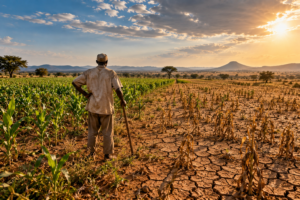
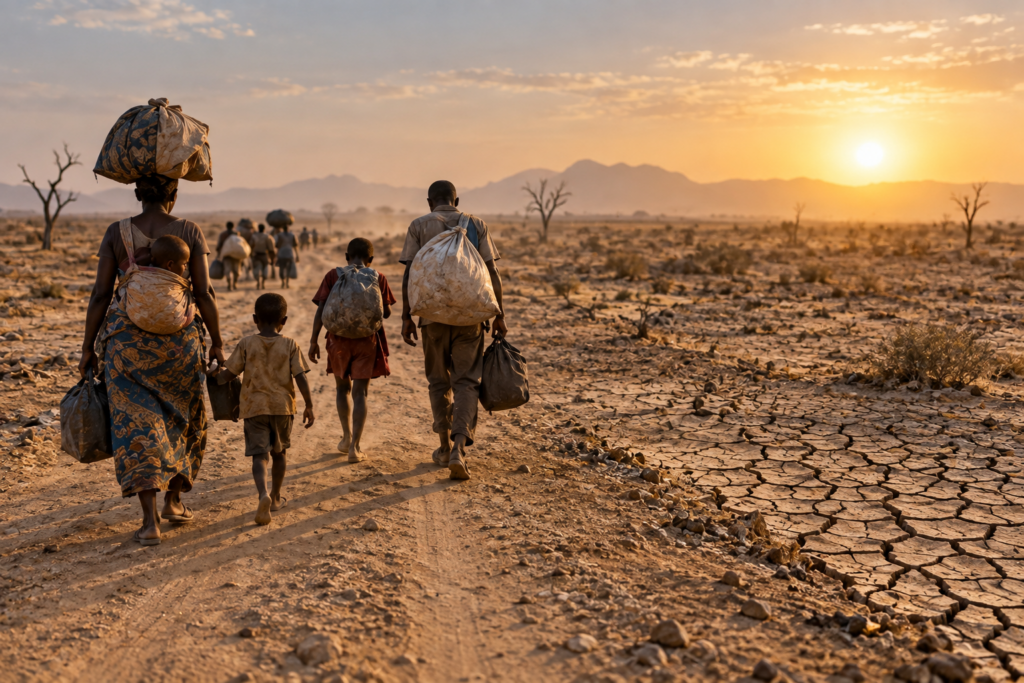
In 2005, a striking number entered the international climate debate:
50 million.
By 2010, the world could be dealing with as many as 50 million people escaping the effects of environmental deterioration.
The warning came from experts associated with the United Nations University and quickly traveled through newspapers, international organizations and the wider environmental debate.
The causes cited included rising seas, desertification, water scarcity, flooding and other forms of environmental degradation.
And unlike many long-term climate projections, this one had an unusually short deadline.
2010.
Only five years away.
That makes it particularly useful for an evidence-based audit.
The question is not whether environmental change can contribute to migration. It can.
The question is much narrower:
When 2010 arrived, could the predicted 50 million environmental refugees actually be identified?
The answer is considerably more complicated than the original headline suggested.
The 2005 Warning
On October 12, 2005, reporting surrounding the United Nations Day for Disaster Reduction carried a warning from the United Nations University's Institute for Environment and Human Security.
The international community, it said, might soon have to deal with as many as 50 million people escaping the effects of environmental deterioration by 2010.
Contemporary reporting described pressures including desertification, rising sea levels, flooding and storms.
Janos Bogardi, then director of the UNU institute in Bonn, warned that deteriorating environmental conditions could drive rapidly increasing displacement.
The message was urgent.
The world needed to prepare for a new category of displaced people.
And the number attached to that warning was enormous:
50,000,000 people.
Contemporary reporting also makes an important qualification clear: the figure was presented as an estimate or possible upper-end outcome rather than a census-like certainty. Reuters coverage at the time described Bogardi's 50-million estimate as, in some respects, a worst-case scenario.
That qualification must remain attached to the claim.
But so must the date.
2010.
“Environmental Refugee” Was Already a Problematic Term
Before checking the number, we have to ask what was being counted.
What exactly is an environmental refugee?
This is where the prediction begins to encounter a major methodological problem.
“Refugee” has a specific meaning in international law.
Environmental change, by itself, does not create a separate legal category of “environmental refugee” under the international refugee framework.
Later United Nations University discussion explicitly noted that the International Organization for Migration discouraged use of the expression environmental refugees, and that the term had no standing as a refugee category under international refugee law.
That distinction is crucial.
A person can be displaced by a flood without becoming a refugee.
A farmer can move because agricultural conditions deteriorate without becoming a refugee.
A family can relocate within its own country.
Someone can migrate temporarily and later return.
Another person can cross an international border for reasons involving employment, conflict, family, drought and poverty simultaneously.
All are movements of people.
They are not automatically the same statistical category.
DISPLACEMENT ≠ MIGRATION
MIGRATION ≠ INTERNATIONAL MIGRATION
INTERNATIONAL MIGRATION ≠ REFUGEE STATUS
ENVIRONMENTAL PRESSURE ≠ A SINGLE, EXCLUSIVE CAUSE OF MIGRATION
The Attribution Problem
There is another complication.
Why does a person move?
Consider a hypothetical farming family experiencing repeated drought.
Their crops produce less.
Income falls.
Food prices rise.
One member of the family moves to a city looking for employment.
Was that person displaced by climate?
By drought?
By economics?
By unemployment?
By agricultural policy?
By the search for better opportunities?
Possibly by several of them.
Human migration is usually multicausal.
That makes a global count of “climate refugees” fundamentally different from counting something physically observable such as square kilometers of sea ice.
A satellite can measure sea-ice extent using a defined methodology.
There is no satellite capable of looking at a migrant and determining:
72 percent climate, 18 percent economic conditions, 10 percent family circumstances.
The classification requires definitions, surveys, causal assumptions and decisions about what counts.
That does not mean environmentally influenced migration is imaginary.
It means measurement is difficult.
Then 2010 Arrived
The deadline passed.
But there was no internationally standardized dataset demonstrating that the world now contained the predicted 50 million environmental refugees.
Indeed, a later review prepared in the context of climate-related migration research noted that the United Nations University had warned in 2005 that 50 million environmental refugees should be expected worldwide by 2010 and stated that the prediction had not been validated.
This is essentially the conclusion reached in CLIMATE: THE PREDICTIONS THAT EXPIRED.
The book's audit records the claim as:
DEADLINE: by 2010
CLAIM: up to 50 million people fleeing environmental degradation
and concludes that no comparable, internationally harmonized count of 50 million was demonstrated at the deadline.
But there is an important reason not to write:
“There were zero climate refugees.”
That would be just as misleading.
Millions of People Really Were Being Displaced
Natural disasters and environmental pressures unquestionably displaced people before, during and after 2010.
Floods forced people from homes.
Storms caused evacuations.
Drought affected livelihoods.
Coastal erosion threatened settlements.
Desertification and land degradation contributed to economic pressures.
Some movements were temporary.
Others became permanent.
Some occurred entirely within national borders.
Others contributed to international migration.
Environmental factors therefore belonged in the study of human mobility.
The problem was not the proposition that environmental conditions could influence migration.
The problem was converting that complex reality into one enormous global number attached to one short deadline.
A Number Without a Stable Denominator
Suppose researchers counted everyone temporarily evacuated by an extreme-weather event.
The number would be very large.
Suppose instead they counted only people permanently forced from their homes primarily because of long-term environmental deterioration.
The number would be smaller.
Suppose they counted only people crossing an international border.
Smaller again.
Suppose they counted only people qualifying as refugees under international law.
Now they would be measuring an entirely different category.
This means the statement:
“There will be 50 million environmental refugees”
cannot be evaluated properly until “environmental refugee” has a stable operational definition.
The original debate itself recognized this problem. Contemporary reporting quoted Bogardi calling for international agreements and for a way to distinguish environmental refugees from economic migrants.
In other words, the prediction was being publicized while the category being predicted was itself still being debated.
That is a major methodological warning sign.
Environmental Migrant Is Not the Same as Climate Refugee
There is another transformation worth noticing.
The 2005 material frequently referred to environmental refugees.
Today the claim is often remembered as:
“50 million climate refugees by 2010.”
Those formulations are not identical.
Environmental degradation can include processes whose relationship with anthropogenic climate change ranges from direct to indirect to uncertain.
Land degradation may involve land management.
Water scarcity can involve rainfall, population growth, infrastructure, extraction and governance.
Flood losses depend not only on climate but also on where people build and how they protect settlements.
Calling every person affected by an environmental pressure a climate refugee therefore adds another causal step.
This audit should not silently add that step.
The popular phrase is useful for finding the historical claim.
The evidence requires the more precise original language.
How a Conditional Warning Becomes a Headline
This case demonstrates one of the recurring mechanisms examined throughout CLIMATE: THE PREDICTIONS THAT EXPIRED.
The underlying subject is complicated.
Environmental change can affect migration.
Researchers discuss vulnerability.
Institutions consider possible future displacement.
A large upper-end estimate appears.
Then the communication chain compresses everything.
Complex risk assessment
becomes
possible 50 million
which becomes
50 million environmental refugees by 2010
and can eventually be remembered as
50 million climate refugees by 2010.
At each stage, uncertainty becomes less visible.
The number becomes more memorable.
The deadline becomes more powerful.
Why 50 Million Was Such a Powerful Number
Fifty million is difficult to visualize.
In 2005, contemporary reporting compared it with the population of a major European country.
That comparison transformed an abstract estimate into something imaginable.
Not thousands.
Not hundreds of thousands.
An entire nation's worth of people.
The number therefore possessed all the characteristics of a powerful headline:
Large.
Global.
Human.
Urgent.
Dated.
But those same characteristics make post-deadline verification essential.
If a number is specific enough to generate urgency before the deadline, it must remain specific enough to be audited afterward.
Did the Prediction “Fail”?
This is where wording matters.
If the prediction is interpreted as:
“Environmental pressures will contribute to human displacement.”
Then it did not fail.
That phenomenon is real.
But that is not the interesting part of the 2005 warning.
The auditable element was:
up to 50 million environmental refugees by 2010.
When 2010 arrived, no internationally harmonized measurement demonstrated such a population.
And because “environmental refugee” lacked a standardized legal and statistical definition, the headline number could not simply be verified by consulting a global refugee register.
That is why the verdict should not be:
“Climate migration was disproved.”
It wasn't.
Nor should it be:
“The prediction was correct because environmental displacement exists.”
That does not demonstrate the predicted number.
The correct conclusion is narrower.
THE VERDICT
PREDICTION: The world could face as many as 50 million people escaping environmental deterioration by 2010.
SOURCE CONTEXT: United Nations University / Institute for Environment and Human Security warning publicized in 2005.
DEADLINE: 2010.
WHAT HAPPENED: Environmental disasters and degradation continued to displace people, but no internationally harmonized dataset demonstrated a population of 50 million “environmental refugees” corresponding to the prediction at the deadline. Later research reviewing the forecast described it as unvalidated.
DEFINITION PROBLEM: “Environmental refugee” was not — and is not — a separate internationally recognized refugee category simply created by environmental displacement.
VERDICT: THE 50-MILLION-BY-2010 NUMBER WAS NOT DEMONSTRATED BY THE DEADLINE. THE UNDERLYING PHENOMENON OF ENVIRONMENTALLY INFLUENCED DISPLACEMENT IS REAL. THE DEFINITION MATTERS.
That distinction is the point.
A failed numerical forecast does not prove that the underlying risk is imaginary.
A real underlying risk does not prove that every numerical forecast about it was accurate.
Both statements can be true at the same time.
ENVIRONMENTAL DISPLACEMENT IS REAL.
50 MILLION BY 2010 WAS NOT DEMONSTRATED.
And a prediction with a deadline should still be examined after the deadline passes.
From the Book
This article is adapted from the investigation presented in Patrick Panteix's CLIMATE: THE PREDICTIONS THAT EXPIRED — What We Were Told. What Actually Happened. Who Profited.
The book audits 100 environmental and climate predictions by preserving the original wording, conditions and deadline before comparing them with observations available after that deadline.
100 predictions. 100 verdicts.
SOURCES
United Nations University / Institute for Environment and Human Security (UNU-EHS) — “Environmental Refugees to Top 50 Million in 5 Years” (October 11, 2005)
The original UNU warning stated that by 2010 the world might have to cope with as many as 50 million people escaping the effects of “creeping environmental deterioration.”
https://news.mongabay.com/2005/10/environmental-refugees-to-top-50-million-in-5-years/
Reuters — “Surge in Eco-Refugees Predicted” (October 11, 2005)
Contemporary reporting on the UNU-EHS warning. UNU-EHS director Janos Bogardi described the estimate of 50 million environmental refugees as, in some respects, a worst-case scenario.
https://www.aljazeera.com/news/2005/10/11/surge-in-eco-refugees-predicted
Euractiv — “Millions to Flee Climate Disasters by 2010, UN Warns” (October 12, 2005)
Contemporary account of the UNU-EHS warning, including the 2010 deadline and the distinction between “environmental refugees” and refugees recognized under international law.
https://www.euractiv.com/news/millions-to-flee-climate-disasters-by-2010-un-warns/
UNFCCC — “Forecasts of Future Climate-Related Migration”
Review of climate-related migration forecasts. It specifically records the 2005 UNU-EHS warning of 50 million environmental refugees worldwide by 2010 and states that the prediction had not been validated.
https://seors.unfccc.int/applications/seors/attachments/get_attachment?code=4IJKYQFT9R5OTHAQU09LRBA75X3T9BAK
United Nations University — “Environmental Migrants: More Than Numbers”
UNU discussion of environmental migration and the problems surrounding terminology and numerical estimates. It notes that “environmental refugees” has no legal standing under international refugee law and that the International Organization for Migration discourages use of the term.
https://ourworld.unu.edu/en/environmental-migrants-more-than-numbers
UNHCR / Forced Migration Review — “The Numbers Game” (2008)
Review of widely varying estimates of future climate-related migration. It discusses the UNU-EHS prediction of 50 million environmental refugees by 2010 and explains the major uncertainties involved in forecasting climate-related migration.
https://www.unhcr.org/innovation/wp-content/uploads/2017/02/FMR31.pdf