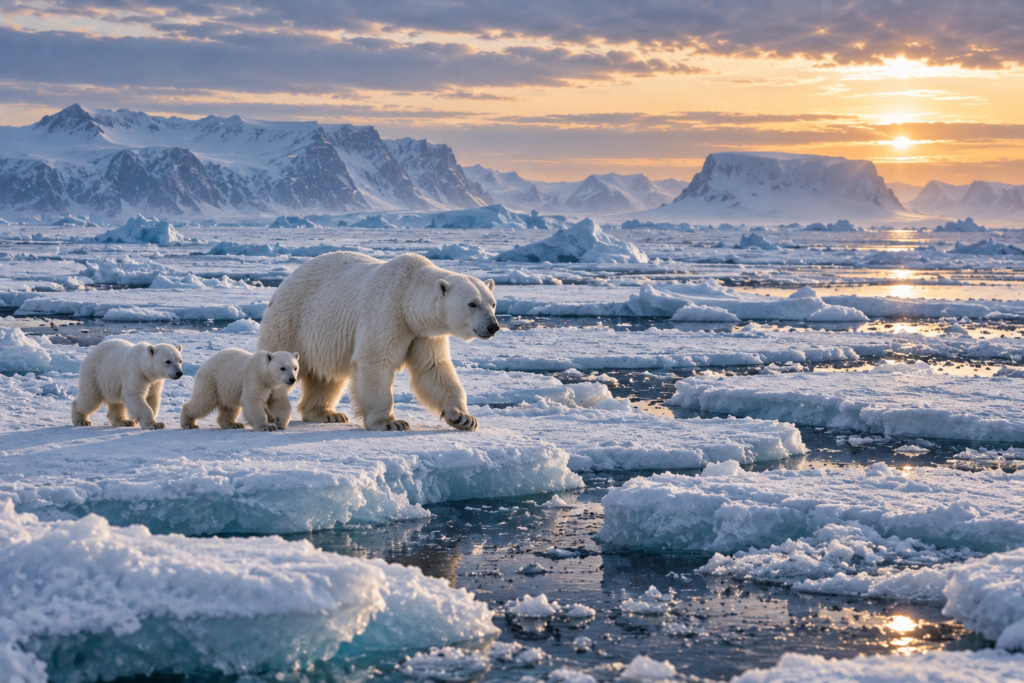
Few animals became as closely associated with climate change as the polar bear.
For decades, images of bears standing on shrinking pieces of sea ice have accompanied stories about global warming.
And some of the predictions were dramatic.
Polar bears would disappear.
Two-thirds could be gone.
Some populations might vanish within decades.
In 2006, one widely reported claim even placed extinction of the species at approximately 2030.
But what was actually predicted?
And what does the population evidence show?
The answer requires one distinction before anything else:
THE SPECIES ≠ A REGIONAL POPULATION ≠ A LOCAL SUBPOPULATION
Without that distinction, almost every discussion of polar-bear predictions becomes misleading.
The 2030 Extinction Claim
In April 2006, Australian scientist and author Tim Flannery appeared on the Canadian Broadcasting Corporation's The House.
He made an extraordinary statement.
According to a contemporary U.S. Geological Survey account, Flannery said that projections from polar-bear specialists indicated that around 2030, the species would become extinct because global warming was changing Arctic sea ice.
That is an unusually specific claim.
But something important happened immediately afterward.
Steven Amstrup, one of the world's leading polar-bear researchers, addressed the controversy in a 2006 paper titled:
“Future for polar bears in a declining sea ice environment: What do we know?”
His analysis made clear that the scientific evidence at the time did not justify treating global extinction by 2030 as an established scientific projection.
So already we have our first distinction:
A PUBLIC STATEMENT ABOUT WHAT SCIENTISTS PROJECT ≠ THE ACTUAL SCIENTIFIC PROJECTION
Then Came the Major USGS Projection
The scientific case became much more quantitative in 2007.
The U.S. Geological Survey conducted extensive modeling for the U.S. Fish and Wildlife Service as the federal government considered protection of polar bears under the Endangered Species Act.
The conclusion received enormous attention.
Under the business-as-usual greenhouse-gas scenario used in the analysis, approximately two-thirds of the world's polar bears could disappear by mid-century as their sea-ice habitat declined.
That was a serious scientific projection.
But notice the words:
TWO-THIRDS
not all polar bears.
BY MID-CENTURY
not 2020.
And:
UNDER A BUSINESS-AS-USUAL EMISSIONS SCENARIO
not regardless of what happened to greenhouse-gas emissions.
Those distinctions matter.
Polar Bears Depend on Sea Ice
The biological mechanism behind the concern is straightforward.
Polar bears depend heavily on sea ice as a platform from which they hunt seals.
Less sea ice can mean longer periods on land.
Longer periods away from productive hunting habitat can affect body condition.
That can affect reproduction.
It can affect cub survival.
Eventually it can affect population abundance.
The concern was therefore not invented for a headline.
It was based on a real ecological relationship.
The USGS summarizes the issue directly: polar bears depend on sea ice over biologically productive Arctic continental shelves to hunt seals. The U.S. Fish and Wildlife Service listed the species as threatened under the Endangered Species Act in 2008 because of projected population declines associated with sea-ice loss.
The question is not whether sea ice matters.
It does.
The question is whether particular predictions occurred on their stated timetable.
Western Hudson Bay Became the Test Case
One of the most intensively studied polar-bear populations lives in Western Hudson Bay, Canada.
These bears became particularly important to climate research because Hudson Bay melts seasonally.
When the ice disappears, bears come ashore.
When it freezes again, they return to the ice.
Changes in the timing of breakup and freeze-up therefore affect the length of time bears spend on land.
Western Hudson Bay provided scientists with something extremely valuable:
a long observational record.
And that record showed genuine problems.
The Population Declined
This is where an evidence audit must resist the temptation to choose only the convenient numbers.
The Western Hudson Bay population did decline.
The current IUCN/SSC Polar Bear Specialist Group assessment gives an estimated 618 bears in 2021, with a confidence interval of 425 to 899.
The group classifies the long-term trend from 1995 to 2021 as:
VERY LIKELY DECREASED
and the shorter-term trend from 2011 to 2021 also as:
VERY LIKELY DECREASED.
The 2021 point estimate was approximately 26.7% below the 2016 estimate.
The Specialist Group also identifies concerns including changing sea-ice breakup and freeze-up, declining body condition and lower productivity.
Those are not trivial changes.
But Western Hudson Bay Did Not Disappear
Here is the other half of the evidence.
Despite the decline, Western Hudson Bay still had an estimated population of hundreds of polar bears in 2021.
It was not locally extinct.
That matters because our book audits a specific historical prediction concerning this population around the 2020 horizon.
The prediction did not simply say that conditions would become worse.
It contemplated possible local extinction around 2020 under the stated conditions.
The deadline arrived.
The population remained.
Our manuscript therefore records the case as:
DEADLINE FAILED — CONDITION PRESERVED.
That verdict contains both sides of the evidence.
The population declined.
The predicted local extinction did not occur by the deadline.
Decline Is Not Extinction
This distinction seems obvious.
But it disappears surprisingly often in environmental reporting.
DECLINING POPULATION ≠ EXTINCT POPULATION
A population can decline by 10 percent.
It can decline by 30 percent.
It can decline by 70 percent.
Those outcomes can be ecologically serious.
But none is equivalent to zero.
Likewise:
LOCAL EXTIRPATION ≠ GLOBAL EXTINCTION
If polar bears disappear from one region, the species can still exist elsewhere.
And:
ONE SUBPOPULATION ≠ ALL POLAR BEARS
That last distinction is particularly important.
There Is No Single Polar-Bear Trend
Polar bears are distributed around the circumpolar Arctic.
Scientists divide them into geographically distinct subpopulations.
And those populations are not all moving in the same direction.
At its 2024 working meeting, the IUCN/SSC Polar Bear Specialist Group recognized 20 subpopulations.
Based on the information available at that time:
3 were likely decreasing.
5 were likely stable.
2 were likely increasing.
10 were data deficient.
That is a much more complicated picture than:
“Polar bears are disappearing.”
But it is also more complicated than:
“Polar bears are doing fine.”
Neither slogan captures the evidence.
Southern Hudson Bay Shows Why This Matters
Consider the neighboring Southern Hudson Bay population.
The latest estimate listed by the Polar Bear Specialist Group is approximately 1,119 bears, based on the 2021 assessment.
Its long-term trend from 1986 to 2021 is classified as:
LIKELY STABLE
and its short-term trend from 2012 to 2021 is also:
LIKELY STABLE.
Yet researchers still report concerns about increased time on land, body condition and cub survival.
So even the word stable does not mean:
NO PROBLEM.
And the word declining does not mean:
EXTINCTION HAS OCCURRED.
Population science requires more precision than that.
What About the World's Polar Bears?
The IUCN/SSC Polar Bear Specialist Group currently cites a global abundance estimate with a 95% confidence interval of approximately 22,000–31,000 bears.
That number should be handled carefully.
It is an estimate assembled from multiple subpopulations.
Some are well studied.
Others are not.
Some population estimates are relatively recent.
Others rely on older information.
The Specialist Group itself emphasizes these limitations.
So a global total should not be treated as if scientists counted every polar bear in the Arctic.
They did not.
The Mid-Century Prediction Has Not Expired
This is another essential rule of our audit.
The major USGS projection concerned approximately 2050.
We are not there yet.
Therefore it would be methodologically wrong to place the two-thirds-by-mid-century projection in the same category as an expired 2020 prediction.
We cannot say it failed.
We cannot say it succeeded.
THE DEADLINE HAS NOT ARRIVED.
Our audit must apply the same rule regardless of whether a prediction supports or contradicts the argument someone wants to make.
A future prediction remains a future prediction.
The Projection Also Changed
In 2010, Amstrup and colleagues published an important follow-up.
The earlier modeling had concentrated on a business-as-usual greenhouse-gas scenario.
The new research asked what might happen if greenhouse-gas emissions were reduced.
The result was important.
The researchers concluded that mitigation could preserve substantially more sea-ice habitat and improve the prospects for polar-bear persistence.
In other words, the earlier trajectory was not necessarily destiny.
The USGS summarized the new conclusion this way: under lower greenhouse-gas emissions and reduced additional stressors, polar bears could persist across all four Arctic ecoregions in which they occurred.
Again:
PROJECTION ≠ INEVITABLE OUTCOME
because the projection depends on assumptions.
What the Data Actually Supports
The evidence supports several statements simultaneously.
Polar bears still exist in substantial numbers.
Some subpopulations have declined.
Some appear stable.
Some have increased.
For many, the available evidence is insufficient to establish a trend confidently.
Sea-ice loss is a serious ecological concern for a species that depends heavily on sea ice for hunting.
Western Hudson Bay has experienced a significant documented decline.
But Western Hudson Bay was not extinct around 2020.
And the global species did not disappear.
There is no contradiction among those facts.
The Problem With the Icon
The polar bear became more than an animal.
It became a symbol.
Symbols simplify.
Science usually does the opposite.
A photograph of one bear on a piece of ice cannot tell us the abundance trend of a subpopulation.
A declining subpopulation cannot tell us the trend of every population.
A global abundance estimate cannot tell us what will happen in 2050.
And a projection for 2050 cannot be judged in 2026 as though its deadline had already passed.
That is why the audit has to return to the original unit of measurement.
Which bears?
Where?
What metric?
What scenario?
What deadline?
Without those questions, “polar bears will disappear” tells us almost nothing that can actually be tested.
THE VERDICT
THE POPULAR CLAIM: Polar bears were predicted to disappear because of climate change.
THE RECORD: Multiple claims have existed, and they are not equivalent. A public statement in 2006 described species extinction around 2030; major USGS modeling in 2007 instead projected that approximately two-thirds of the world's polar bears could disappear by mid-century under the emissions scenario analyzed.
THE WESTERN HUDSON BAY CASE: A dated local-extinction projection around the 2020 horizon did not materialize. The population remained present after the deadline.
BUT: The population has genuinely declined. Its 2021 estimate was 618 bears, and the IUCN/SSC Polar Bear Specialist Group classifies its long- and short-term trends as very likely decreased.
THE GLOBAL PICTURE: The latest PBSG assessment recognizes 20 subpopulations with different trends and substantial data gaps.
THE 2050 PROJECTION: NOT YET AUDITABLE AS A FAILED OR SUCCESSFUL DEADLINE.
VERDICT: THE 2020 LOCAL-EXTINCTION DEADLINE FAILED. THE DOCUMENTED POPULATION DECLINE DID NOT.
LOCAL POPULATION ≠ GLOBAL SPECIES
DECLINE ≠ EXTINCTION
PROJECTION ≠ OBSERVATION
2050 ≠ 2026
The audit cuts both ways.
From the Book
This article is part of the evidence-audit approach used in Patrick Panteix's CLIMATE: THE PREDICTIONS THAT EXPIRED — What We Were Told. What Actually Happened. Who Profited.
The method remains the same:
Preserve the original claim.
Preserve the geography.
Preserve the scenario.
Preserve the deadline.
Then compare it with the observable record.
100 predictions. 100 verdicts.
SOURCES
U.S. Geological Survey — Steven C. Amstrup, “Future for Polar Bears in a Declining Sea Ice Environment: What Do We Know?” (2006)
Contemporary USGS discussion recording Tim Flannery’s 2006 statement that polar bears could be extinct around 2030 and examining what polar-bear science actually supported at the time.
https://www.usgs.gov/publications/future-polar-bears-a-declining-sea-ice-environment-what-do-we-know
U.S. Geological Survey — “Greenhouse Gas Mitigation Can Reduce Sea-Ice Loss and Increase Polar Bear Persistence” (2010)
Peer-reviewed follow-up explaining that the 2007 USGS research projected the loss of approximately two-thirds of the world’s polar bears by mid-century under a business-as-usual greenhouse-gas scenario, and examining how mitigation could change that outcome.
https://www.usgs.gov/publications/greenhouse-gas-mitigation-can-reduce-sea-ice-loss-and-increase-polar-bear-persistence
DOI — Amstrup et al., Nature (2010)
https://doi.org/10.1038/nature09653
U.S. Geological Survey — Projected Losses of Arctic Sea Ice and Polar Bear Habitat May Be Reduced if Greenhouse-Gas Emissions Are Stabilized
USGS explanation of the original 2007 projections and the later mitigation scenarios.
https://www.usgs.gov/programs/cmhrp/news/projected-losses-arctic-sea-ice-and-polar-bear-habitat-may-be-reduced-if
U.S. Geological Survey — Changing Arctic Ecosystems: Polar Bear Conservation
USGS overview of polar-bear dependence on sea ice and the modeling used to assess future population persistence.
https://pubs.usgs.gov/fs/2015/3042/
IUCN/SSC Polar Bear Specialist Group — Population Status
Current scientific status table for the world’s polar-bear subpopulations, including abundance estimates, trend assessments and sea-ice information.
https://www.iucn-pbsg.org/population-status/
IUCN/SSC Polar Bear Specialist Group — 2024 Status Report
Detailed status assessment of polar-bear subpopulations, including Western Hudson Bay and Southern Hudson Bay.
https://www.iucn-pbsg.org/wp-content/uploads/2024/11/PBSG-Status-Criteria-and-Report_Final_2024Oct7.pdf
IUCN/SSC Polar Bear Specialist Group — 20th Working Meeting (2024)
Summary of the scientific status of the 20 recognized polar-bear subpopulations.
https://www.iucn-pbsg.org/2024/06/18/20th-working-meeting-of-the-iucn-ssc-polar-bear-specialist-group/