
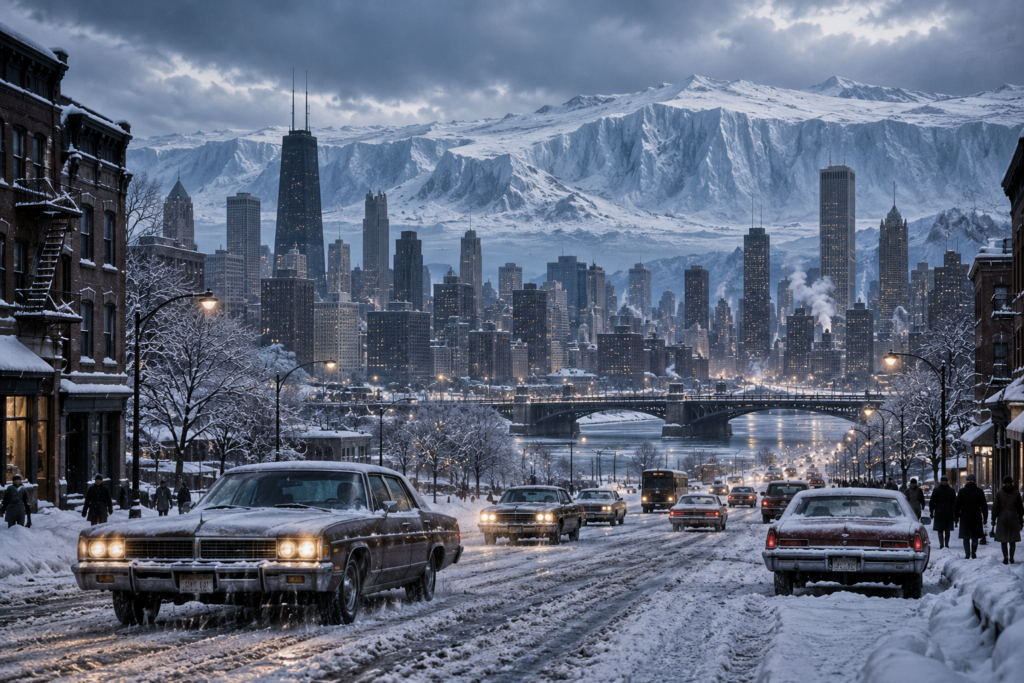
There is a photograph that seems to belong to another climate era.
Snow.
Ice.
A frozen Earth.
And headlines warning that the planet might be entering a period of dangerous cooling.
Today, these images circulate across the internet as evidence that climate scientists once predicted an imminent ice age — only to reverse themselves later and predict global warming instead.
The story is powerful.
It is also too simple.
There really was concern about global cooling during the 1970s.
There really were scientists investigating whether the cooling observed during the middle decades of the twentieth century might continue.
There really were prominent newspaper and magazine articles warning about the consequences.
But there was not a scientific consensus in the 1970s that an ice age was imminent.
To understand what actually happened, we have to separate three different things:
OBSERVED COOLING
SCIENTIFIC HYPOTHESES ABOUT FUTURE COOLING
MEDIA HEADLINES ABOUT AN APPROACHING CLIMATE CRISIS
They are related.
They are not interchangeable.
The World Really Had Cooled
The cooling story did not appear from nowhere.
Global temperatures had not risen continuously through the twentieth century.
After warming during the early part of the century, global mean temperatures flattened and declined somewhat during the middle decades.
Scientists noticed.
And they wanted to know why.
Possible explanations included natural climate variability, changes in solar radiation and — importantly — particles released into the atmosphere by human activity.
Those particles, or aerosols, can reflect incoming sunlight.
More reflection can mean less solar energy reaching Earth's surface.
That creates a cooling influence.
At the same time, however, scientists were also studying something pushing the climate in the opposite direction:
carbon dioxide.
CO₂ traps outgoing infrared radiation and creates a warming influence.
The scientific problem was therefore not simply:
WILL THE EARTH COOL?
It was increasingly:
WHICH EFFECT WILL DOMINATE?
Cooling vs. Warming
This distinction is essential.
Human activity was potentially affecting climate in opposite directions.
AEROSOLS → COOLING
GREENHOUSE GASES → WARMING
Scientists did not yet know precisely how large each effect would become.
Climate models were primitive compared with today's models.
Satellite observations were in their infancy.
The global temperature record was less developed.
The behavior of aerosols was poorly quantified.
Ocean-atmosphere interactions were incompletely understood.
So legitimate scientific uncertainty existed.
Some researchers investigated cooling.
Others projected warming.
Some discussed both possibilities.
That is not evidence that science had reached a consensus on an approaching ice age.
It is evidence of a scientific field trying to understand a complicated system.
Then Came the Headlines
The uncertainty of scientific literature did not always survive its journey into popular media.
One of the most famous examples appeared in Newsweek on April 28, 1975.
The title was:
“The Cooling World.”
Written by Peter Gwynne, the article warned that changes in Earth's weather patterns could produce a major decline in food production.
It suggested that the impact might begin relatively soon — potentially within about a decade.
The article described accumulating evidence of cooling and discussed potentially serious consequences for agriculture and society. A copy of the original article was later entered into a U.S. congressional hearing record, preserving exactly how dramatic the contemporary presentation was.
This was real.
The article existed.
The warnings existed.
But Newsweek was not the scientific literature.
Newsweek ≠ Scientific Consensus
That distinction is probably the most important sentence in this entire article.
A magazine article can quote scientists.
It can discuss scientific studies.
It can reflect genuine scientific concerns.
But it does not establish what the scientific community as a whole believed.
To answer that question, researchers later went back and examined the scientific literature itself.
In 2008, Thomas Peterson, William Connolley and John Fleck published a historical review in the Bulletin of the American Meteorological Society.
They searched the peer-reviewed literature from the period.
Their conclusion was striking.
The scientific literature did not show a global-cooling consensus.
Instead, studies projecting greenhouse warming already substantially outnumbered those projecting cooling.
So two statements can simultaneously be true:
Global cooling was seriously discussed in the 1970s.
and
Global cooling was not the scientific consensus of the 1970s.
There is no contradiction.
What the Scientific Literature Actually Shows
Peterson and his colleagues examined papers published between 1965 and 1979 that made projections about future climate.
Their review identified only a relatively small number predicting cooling, substantially more predicting warming, and others taking a neutral position.
That matters because the popular historical narrative often reverses the proportions.
A handful of memorable cooling predictions and dramatic newspaper headlines can create the impression that an entire scientific discipline expected a new ice age.
The literature does not support that interpretation.
Scientific disagreement existed.
Uncertainty existed.
Cooling research existed.
But so did greenhouse warming research — and in considerably greater numbers.
The National Academy of Sciences Was More Careful
Another important document appeared in 1975.
The U.S. National Research Council published:
Understanding Climatic Change: A Program for Action.
If American climate science had reached a consensus that a new ice age was imminent, this would be an obvious place to find it.
Instead, the report presents something much more cautious.
It emphasizes how poorly future climatic changes could then be predicted and calls for a major research program to improve understanding of the climate system.
The report discussed natural and human influences and stressed society's vulnerability to climate variation.
It did discuss the cooling that had occurred.
It did take climatic change seriously.
But it did not declare that a new ice age was about to engulf civilization.
In fact, when discussing major ice-sheet advances, the report noted that such transformations evolve over thousands of years.
That is very different from the popular image of scientists announcing an imminent glacial apocalypse.
The Famous Ice-Age Story
Why, then, do so many people remember the 1970s as the decade when scientists predicted an ice age?
Because dramatic predictions are memorable.
Magazine covers are memorable.
Television documentaries are memorable.
Headlines are memorable.
Scientific uncertainty is not.
A headline saying:
THE COOLING WORLD
is easy to remember fifty years later.
A research paper discussing uncertainty in aerosol forcing, carbon dioxide concentrations and atmospheric circulation is not.
This produces a historical compression:
SOME SCIENTISTS STUDIED COOLING
becomes
SCIENTISTS PREDICTED COOLING
which becomes
SCIENCE PREDICTED AN ICE AGE
which becomes
SCIENTISTS WERE CERTAIN AN ICE AGE WAS COMING.
Each step changes the original evidence.
But We Should Not Rewrite the Other Side Either
There is an opposite historical mistake.
Because there was no scientific cooling consensus, it would be equally wrong to pretend that cooling warnings never existed.
They did.
Scientists published papers investigating continued cooling.
Journalists interviewed researchers concerned about cooling.
Governments were encouraged to take climatic variability seriously.
Popular publications presented dramatic cooling scenarios.
And some forecasts attached relatively short time horizons to agricultural and climatic consequences.
Those statements should not disappear simply because later climate science developed differently.
The correct historical conclusion is not:
“Everybody predicted an ice age.”
Nor is it:
“Nobody predicted global cooling.”
Both are wrong.
What Happened to the Cooling?
The mid-century cooling trend did not continue.
From the late twentieth century onward, global mean temperature rose substantially.
The balance between competing human influences became clearer.
Aerosol pollution had produced a cooling influence.
Greenhouse gases produced a warming influence.
But greenhouse-gas forcing increasingly dominated the long-term global temperature trajectory.
At the same time, air-pollution controls reduced some aerosol emissions in industrialized countries.
The world therefore did not continue along the cooling trajectory that some researchers and media reports had contemplated.
Was Newsweek Wrong?
This requires another distinction.
The 1975 Newsweek article did not simply say:
“There will be an ice age.”
Its immediate concern centered heavily on cooling-related disruption to weather and agriculture.
It warned that declining food production might begin within approximately a decade.
That outcome did not unfold as described.
Global agriculture did not enter the cooling-driven collapse anticipated in the article.
But judging the entire scientific community by this article would be a category error.
NEWSWEEK ≠ PEER-REVIEWED PAPER
ONE SCIENTIST ≠ SCIENTIFIC COMMUNITY
SCENARIO ≠ CONSENSUS
RESEARCH QUESTION ≠ ESTABLISHED CONCLUSION
That same rule must apply regardless of whether the historical prediction concerns cooling or warming.
Science Changes — But That Is Not the Whole Story
It is sometimes said that the global-cooling episode proves that scientists simply changed their minds.
That description misses what actually occurred.
Scientific understanding changed because the evidence changed.
Observations improved.
Temperature records improved.
Satellites provided new measurements.
Climate models improved.
Aerosol effects became better understood.
Greenhouse forcing became better quantified.
And additional decades of observations revealed the direction of the long-term global temperature trend.
Science is supposed to change when evidence improves.
But that does not erase old predictions.
They can still be audited.
The crucial question is simply who made them and how representative they were.
The Historical Record Is More Interesting Than the Myth
The actual story of the 1970s is more revealing than either political caricature.
Scientists were confronting a climate system influenced by multiple competing forces.
They knew atmospheric composition mattered.
They knew human activity could alter climate.
They knew the mid-century temperature record contained a cooling period.
They did not yet know precisely how aerosols, greenhouse gases, oceans and natural variability would interact over coming decades.
Some anticipated cooling.
More anticipated warming.
Others considered the evidence insufficient for a confident projection.
Meanwhile, the media often selected the most dramatic possibilities.
That process should sound familiar.
THE VERDICT
THE CLAIM: Climate science in the 1970s predicted that Earth was heading toward an imminent ice age.
WHAT THE HISTORICAL RECORD SHOWS: Scientists genuinely investigated global cooling, and some scientific papers projected continued cooling. Major media outlets also published dramatic cooling warnings.
WHAT IT DOES NOT SHOW: A scientific consensus that an imminent ice age was coming. A later systematic review of the peer-reviewed literature found substantially more papers projecting warming than cooling.
WHAT HAPPENED: The mid-century cooling did not persist. Global temperatures subsequently rose substantially as greenhouse forcing became dominant over the long-term trajectory.
VERDICT: THE POPULAR CLAIM OF A 1970s SCIENTIFIC “GLOBAL COOLING CONSENSUS” IS NOT SUPPORTED BY THE SCIENTIFIC LITERATURE.
THE COOLING CONCERN WAS REAL.
THE COOLING HEADLINES WERE REAL.
SOME COOLING PREDICTIONS WERE REAL.
THE CLAIM THAT SCIENCE AS A WHOLE PREDICTED AN IMMINENT ICE AGE IS NOT.
That distinction is precisely why historical predictions should be examined from their original sources rather than reconstructed from memory.
From the Book
This article is part of the evidence-audit approach used in Patrick Panteix's CLIMATE: THE PREDICTIONS THAT EXPIRED — What We Were Told. What Actually Happened. Who Profited.
The method remains simple:
Preserve the source.
Preserve the wording.
Preserve the deadline.
Preserve the uncertainty.
Then compare what was actually said with what actually happened.
100 predictions. 100 verdicts.
SOURCES
National Research Council — Understanding Climatic Change: A Program for Action (1975)
Official National Academy of Sciences / National Research Council assessment of climatic change and the state of climate-prediction capability in the mid-1970s.
https://www.nationalacademies.org/publications/27501
National Academies — Past Climatic Variations and the Projection of Future Climates
Chapter of the 1975 National Research Council report dealing specifically with past climate variations and the difficulty of projecting future climate.
https://www.nationalacademies.org/read/27501/chapter/5
Peterson, Thomas C.; Connolley, William M.; Fleck, John — “The Myth of the 1970s Global Cooling Scientific Consensus” (2008)
Bulletin of the American Meteorological Society, Vol. 89, No. 9, pp. 1325–1338.
Systematic historical review of the scientific literature examining whether a global-cooling consensus actually existed during the 1970s.
https://journals.ametsoc.org/view/journals/bams/89/9/2008bams2370_1.xml
DOI — Peterson, Connolley & Fleck (2008)
https://doi.org/10.1175/2008BAMS2370.1
NERC Open Research Archive — Peterson, Connolley & Fleck
Repository record and accessible copy of the 2008 literature review.
https://nora.nerc.ac.uk/id/eprint/11584/
U.S. Congressional Hearing Record — Newsweek, “The Cooling World,” Peter Gwynne (April 28, 1975)
The congressional record reproduces the famous Newsweek article warning about cooling, changing weather patterns and potentially serious effects on food production.
https://www.govinfo.gov/content/pkg/CHRG-111hhrg48332/pdf/CHRG-111hhrg48332.pdf