In September 1988, newspaper readers encountered a striking warning from the Maldives.
An AFP dispatch from Malé, published by The Canberra Times, reported that gradual sea-level rise threatened to completely cover the Maldives within the next thirty years, “according to authorities.”
Thirty years created a testable deadline.
Around 2018.
That date has now passed.
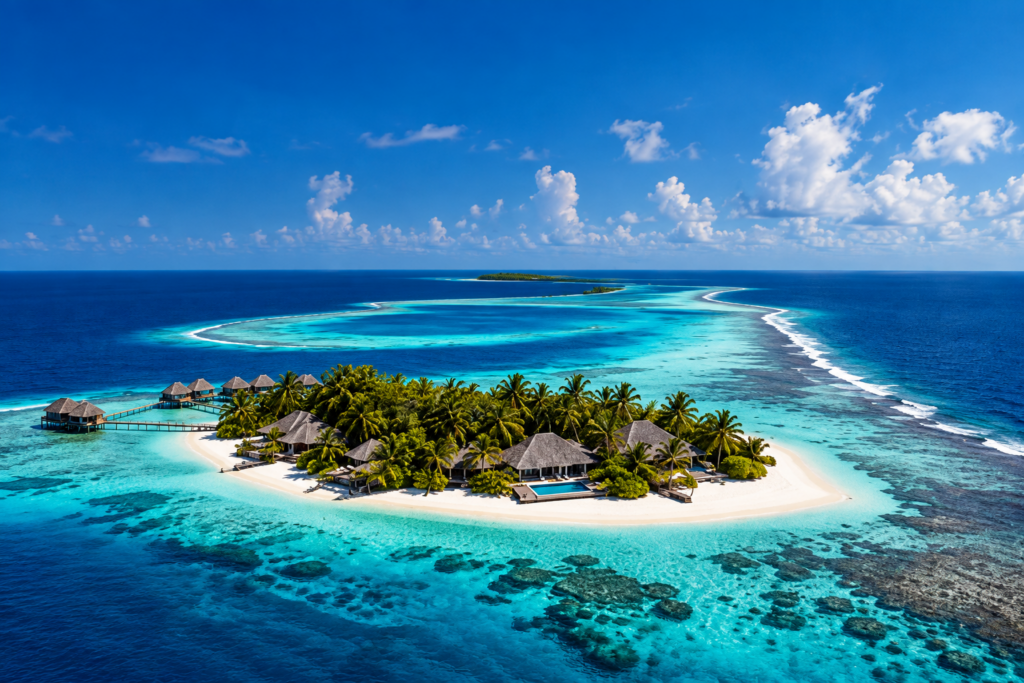
The Maldives were not completely covered. Malé remained inhabited. Airports continued operating. Resorts expanded. Land was reclaimed. And beside the capital, the Maldives built an entirely new island-city: Hulhumalé.
So what happened to the prediction?
What Was Actually Said in 1988?
The original source matters.
The 1988 report did not quote a United Nations scientist predicting with certainty that the Maldives would disappear in 2018.
It was an AFP dispatch from Malé. The article reported the thirty-year national-coverage warning “according to authorities” and separately quoted Maldives Environmental Affairs Director Hussein Shihab.
Shihab said that an estimated sea-level rise of 20 to 30 centimeters over the following 20 to 40 years could be catastrophic for most islands.
Those are not identical claims.
One is a dramatic thirty-year warning about an entire country being completely covered.
The other contains a range, a longer time horizon and an important qualifier: could.
This distinction illustrates one of the central problems examined in CLIMATE: THE PREDICTIONS THAT EXPIRED:
RISK → RANGE → HEADLINE → DEADLINE → MEMORY
Over time, a conditional warning can become remembered as a much simpler statement:
Scientists predicted that the Maldives would disappear by 2018.
That is not an accurate description of the original source.
Then 2018 Arrived
The thirty-year deadline passed.
There was no national submergence.
The archipelago did not vanish. The population was not evacuated to another country. Malé remained the political and economic center of the Maldives.
But that does not mean nothing changed.
Sea level rose. Coastal erosion affected many shorelines. Flooding remained a concern. Reefs, freshwater supplies and infrastructure faced genuine environmental pressures.
The question is therefore not whether the Maldives face coastal risks.
They do.
The question is much narrower:
Did the specific thirty-year outcome reported in 1988 occur?
It did not.
184 Islands Tracked for Four Decades
One of the most interesting pieces of evidence comes from Huvadhoo Atoll.
Researchers Mohamed Aslam and Paul Kench examined 184 vegetated reef islands using aerial photographs and satellite imagery covering periods of approximately 37 to 45 years.
The results were more complicated than either side of the climate debate might expect.
Across all 184 islands, total land area increased by about 59 hectares, or 2.4 percent. But much of that increase resulted from human land reclamation.
When reclaimed islands were excluded, natural island area declined by approximately 28.5 hectares, or 1.5 percent.
About 45 percent of the islands experienced erosion.
About 40 percent remained stable.
About 15 percent increased in area.
And yet, across the 184 islands examined:
Not one island was lost during the study period.
That does not prove that every island in the Maldives is safe or that no Maldivian reef island has ever disappeared.
It demonstrates something more specific and scientifically useful:
Erosion is not the same thing as island disappearance.
The study and its limitations are important because the physical behavior of reef islands is more complicated than a simple bathtub model. Sediment, waves, storms, reef condition, island geometry and human engineering can all influence island shape and area.
Sea-Level Rise Is Not the Same as Island Disappearance
This distinction becomes even more important when discussing measurements.
Global mean sea level, local relative sea level, shoreline position and island area are not interchangeable measurements.
A tide gauge measures water level relative to a reference point.
It does not measure every beach.
A satellite measures sea-surface height over broad areas.
It does not tell us whether sediment has accumulated on one side of a reef island.
And shoreline erosion does not necessarily mean that an island is being vertically submerged.
The World Bank highlighted this complexity in a 2024 analysis of the Maldives. Reviewing multi-decadal island studies, it found no uniform, widespread contraction in the datasets discussed and cautioned that sea-level change alone currently lacks an empirical basis as a predictor of future island-area change.
That is not the same as saying sea-level rise is harmless.
The same World Bank work warns about future flooding, infrastructure exposure and substantial adaptation costs.
The Island the Maldives Built
Perhaps the most striking contradiction between the old countdown and what actually happened is Hulhumalé.
Land reclamation began in the late 1990s.
Instead of abandoning the region, the Maldives created a large new island beside Malé and began building a city on it.
The engineered land was raised above the elevation typical of many natural Maldivian islands.
The chronology is remarkable.
1988: readers were warned that rising seas threatened to completely cover the Maldives within thirty years.
During those thirty years: the Maldives began constructing a new island and building a city on it.
Engineering does not make future sea-level rise disappear.
But it does demonstrate why treating an inhabited country as a passive sandbank produces misleading predictions.
The Maldives Continued to Invest
The economic story did not stop in 2018.
By the mid-2020s, the Maldives were receiving more than two million tourists annually, while resorts, airports and other infrastructure continued to expand.
And investment continued well beyond the original deadline.
In 2026, the Maldivian government reported thousands of new tourist beds established over the previous two years and additional resorts scheduled to open.
A $790 million private-sector township project was launched with a planned 2028 completion date.
Land reclamation also continued.
None of this proves that future climate risk is zero.
Investors can be wrong. Governments can make poor decisions. People routinely build valuable assets in areas exposed to hurricanes, floods, earthquakes and other hazards.
But investment tells us something about what actually happened during and after the original thirty-year countdown:
The Maldives did not physically disappear. They continued building.
The Risk Did Not Expire
This is where the distinction becomes essential.
A failed prediction does not mean that the underlying hazard is imaginary.
Current scientific assessments continue to identify serious risks for low-lying islands, including more frequent flooding, extreme sea levels, freshwater contamination, reef degradation, infrastructure exposure and substantial adaptation costs.
Those risks deserve to be evaluated using their own assumptions and their own time horizons.
But a new projection cannot retroactively replace an old prediction after its deadline passes.
And an old failed deadline cannot invalidate every new projection.
Both statements can be true.
The Verdict
The original public claim can now be tested.
CLAIM: A 1988 report said gradual sea-level rise threatened to completely cover the Maldives within thirty years.
DEADLINE: Approximately 2018.
WHAT HAPPENED: The Maldives remained inhabited and economically active. Malé remained. Hulhumalé expanded. Land was reclaimed. Tourism and infrastructure continued developing.
184-ISLAND STUDY: No island in the Huvadhoo study sample disappeared during approximately four decades of observation, although many experienced erosion and natural island area declined slightly when reclamation was excluded.
UNDERLYING HAZARD: Real. Coastal erosion, flooding, freshwater stress, reef degradation and future sea-level rise remain serious concerns.
VERDICT: FAILED DEADLINE — REAL UNDERLYING HAZARD.
The Maldives case does not show that climate change is false.
It shows something more useful.
A real hazard does not make every deadline true.
The risk was real.
The deadline was not.
From the book
This article is adapted from the investigation presented in Patrick Panteix's CLIMATE: THE PREDICTIONS THAT EXPIRED — What We Were Told. What Actually Happened. Who Profited.
The book audits climate and environmental predictions by returning to the original source, identifying the actual claim and deadline, and comparing it with the evidence available after that deadline.
100 predictions. 100 verdicts.
SOURCES
The Canberra Times / Agence France-Presse — “Threat to islands” (September 1988)
Original contemporary report of the warning that a gradual rise in average sea level threatened to completely cover the Maldives within 30 years.
https://trove.nla.gov.au/newspaper/
Permanent Service for Mean Sea Level (PSMSL) — Malé / Hulhulé Sea-Level Station
Observed tide-gauge record for the Maldives.
https://psmsl.org/data/obtaining/stations/1753.php
Permanent Service for Mean Sea Level (PSMSL) — Gan II Sea-Level Station
Long-term observed sea-level record for the southern Maldives.
https://psmsl.org/data/obtaining/stations/1707.php
World Bank — Sea-Level Rise and Coastal Changes in Maldives (2024)
Assessment of observed and projected sea-level rise, coastal change, exposure and adaptation in the Maldives.
https://documents1.worldbank.org/curated/en/099120224122530614/pdf/P180529-797a800b-f0d0-4d86-9849-f41d7e79f42b.pdf
World Bank — Maldives Country Climate and Development Report (2024)
Assessment of climate risks to the Maldives, including sea-level rise, coastal flooding, coral reefs and adaptation.
https://www.worldbank.org/en/news/press-release/2024/09/13/climate-change-threatens-maldives-fisheries-and-tourism-urgent-adaptation-needed