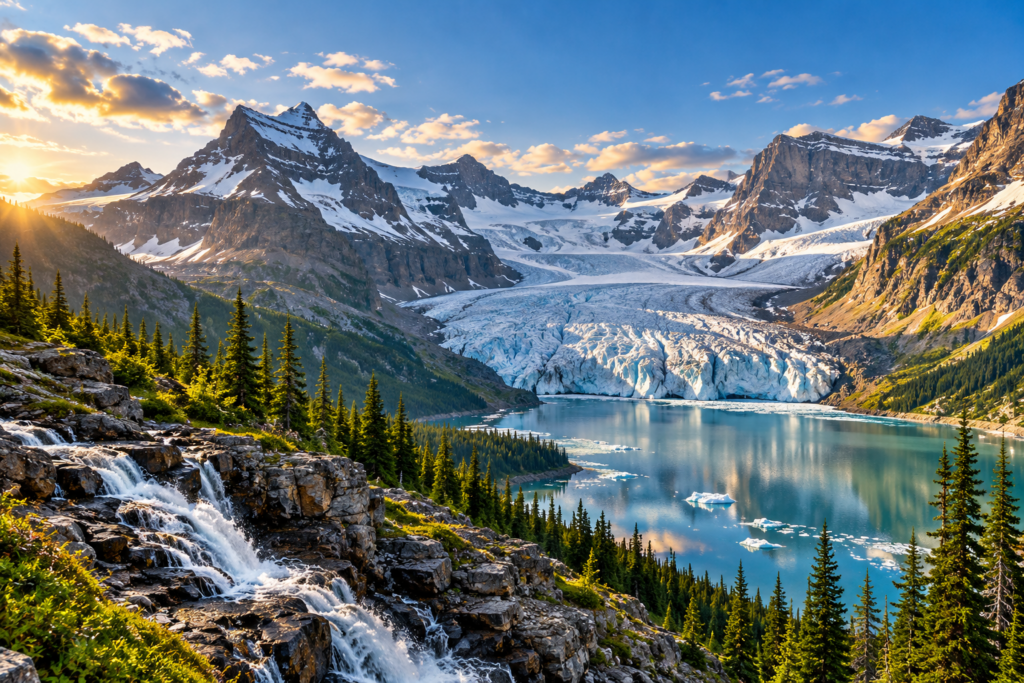
Glacier National Park has one of the most memorable names in the American landscape.
For years, visitors to the Montana park also encountered an equally memorable warning: its glaciers could soon disappear.
Eventually, one date became attached to that warning:
2020.
The prediction appeared in park exhibits. Visitors photographed the signs. The date circulated through news stories and climate discussions.
Then 2020 arrived.
The glaciers were still there.
That simple fact has since been used in two very different ways. Critics cite it as evidence that climate warnings cannot be trusted. Defenders point out that Glacier National Park's glaciers really have retreated dramatically.
Both arguments miss the most interesting part of the story.
The retreat was real. The 2020 deadline was not.
Where Did the Prediction Come From?
The story begins with scientific research, not a park sign.
In 2003, researchers Myrna Hall and Daniel Fagre published a study modeling climate-induced glacier change in Glacier National Park.
Their work examined the Blackfoot–Jackson Glacier Basin and projected how the glaciers could change under a warming scenario.
The model indicated that glaciers in the modeled basin could disappear around 2030.
That distinction matters.
The original research did not simply declare that every glacier in Glacier National Park would certainly vanish on a specific date.
It was a model result.
It had a geographic scope.
It depended on assumptions.
And its approximate date was 2030.
Then the clock changed.
How 2030 Became 2020
By 2009, researchers believed that Blackfoot and Jackson glaciers were shrinking faster than the earlier model had anticipated.
According to the National Park Service's own retrospective account, an informal estimate moved the possible disappearance date forward.
From approximately 2030...
to approximately 2020.
That new date began appearing in public-facing exhibits in Glacier National Park.
And this is where the nature of the message changed.
A model projection with assumptions and uncertainty had become something much easier for visitors to remember:
The glaciers will be gone by 2020.
The National Park Service itself now documents how this happened.
A Date Is More Powerful Than a Trend
“Glaciers are retreating” describes an observed process.
“Glaciers may continue retreating under future warming” is a projection.
“Gone by 2020” is a countdown.
Those statements are related.
They are not equivalent.
A countdown has an unusual property: eventually, the calendar tests it.
No sophisticated climate model is required to determine whether a glacier predicted to disappear by 2020 still exists after 2020.
You can look.
Then 2020 Arrived
As the deadline approached, something became obvious.
The glaciers were not going to disappear.
The National Park Service now states that prediction dates were removed from park exhibits as 2020 approached and it became clear that glaciers would remain.
Jackson Glacier remained.
Blackfoot Glacier remained.
The deadline had expired.
That does not mean the glaciers had returned to their nineteenth-century dimensions.
They had not.
It does not mean glacier retreat had stopped.
It had not.
It means something much narrower and much easier to verify:
The publicly displayed 2020 disappearance date was wrong.
But the Glaciers Really Did Shrink
This is the part that should prevent the story from becoming a simplistic “scientists were wrong” headline.
Glacier National Park has experienced substantial long-term glacier loss.
Historical photographs, mapping and measurements document major reductions in glacier area since the end of the Little Ice Age.
The National Park Service continues to document that retreat.
So does the failure of the 2020 deadline somehow prove that the underlying phenomenon was imaginary?
No.
That would confuse two different questions.
Did the glaciers retreat substantially?
Yes.
Did Jackson and Blackfoot disappear by 2020?
No.
Both statements can be true simultaneously.
Why Exact Glacier Deadlines Are Difficult
A glacier does not shrink like an ice cube on a kitchen counter.
Its future depends on many interacting variables.
Snow accumulation matters.
Summer temperature matters.
Elevation matters.
Topography matters.
Shading matters.
Debris cover matters.
The geometry and thickness of the glacier matter.
And climate conditions themselves vary from year to year.
Area, thickness and volume also do not necessarily decline at the same rate.
A broad, low-elevation section of a glacier may disappear relatively quickly while a smaller high-elevation remnant survives much longer.
That is why a general projection of continued glacier loss can be much more robust than predicting the exact calendar year when the last qualifying piece of ice will cease to meet the definition of a glacier.
CONTINUED RETREAT ≠ EXACT DISAPPEARANCE DATE
The distinction is scientifically important.
It is also easily lost in public communication.
“Continued retreat is expected” is not a memorable headline.
“Gone by 2020” is.
What Happened to the Signs?
The signs became part of the story themselves.
As 2020 approached, the National Park Service removed or changed exhibits containing the outdated disappearance date.
That action has sometimes been portrayed as an attempt to erase an embarrassing prediction.
The National Park Service's own retrospective explanation provides a less dramatic and more useful account.
The original 2003 model had suggested approximately 2030 for the modeled basin. Researchers later believed the glaciers were retreating faster than expected and informally advanced the estimate to approximately 2020. That date was incorporated into public exhibits.
As observations accumulated, it became clear the 2020 estimate would not hold.
The date was therefore removed.
The important part is not that an institution updated a sign when new evidence became available.
Updating information is exactly what scientific institutions should do.
The important part is that the original prediction and its outcome should remain visible in the historical record.
Otherwise, an expired deadline simply disappears while a new projection takes its place.
Prediction, Observation and Revision
Glacier National Park provides a useful example of how a climate countdown can develop.
OBSERVATION
Glaciers are retreating.
↓
MODEL
Continued warming produces continued glacier loss.
↓
PROJECTION
Glaciers in the modeled basin could disappear around 2030.
↓
REVISION
Observed retreat appears faster than anticipated.
↓
PUBLIC DEADLINE
Approximately 2020.
↓
OBSERVATION
2020 arrives. The glaciers remain.
That final step is essential.
A prediction should not stop being testable simply because the date has passed.
What Should Have Happened in 2020?
Ideally, the expiration of the prediction should have triggered a visible post-mortem.
Why did the disappearance estimate fail?
Was the rate of retreat extrapolated too aggressively?
Did glacier geometry cause surviving ice to persist longer than expected?
Did climatic variability differ from assumptions?
Was the informal 2020 estimate less robust than the public presentation suggested?
And most importantly:
What should be communicated differently next time?
Changing a prediction when new evidence arrives is not a scientific failure.
Pretending that the old prediction never existed would be.
Science improves by comparing expectations with observations.
The Verdict
The Glacier National Park case can therefore be separated into several distinct claims.
OBSERVED TREND: Glacier National Park experienced substantial long-term glacier retreat.
ORIGINAL MODEL: A 2003 study projected disappearance around 2030 for glaciers in the modeled Blackfoot–Jackson basin under its warming scenario.
LATER ESTIMATE: By approximately 2009, an informal estimate moved the possible disappearance date forward to 2020.
PUBLIC COMMUNICATION: The 2020 date appeared in National Park Service exhibits.
DEADLINE: 2020.
OBSERVED OUTCOME: Jackson and Blackfoot glaciers remained after the deadline.
INSTITUTIONAL RESPONSE: The National Park Service removed the prediction dates from exhibits and now publicly explains why.
VERDICT: REAL GLACIER RETREAT — FAILED 2020 DEADLINE.
That verdict does not require choosing between “climate change is real” and “the prediction was wrong.”
The evidence permits both conclusions.
The glaciers retreated.
The prediction expired.
A REAL TREND DOES NOT MAKE EVERY DEADLINE TRUE.
From the Book
This article is adapted from the investigation presented in Patrick Panteix's CLIMATE: THE PREDICTIONS THAT EXPIRED — What We Were Told. What Actually Happened. Who Profited.
The book audits climate and environmental predictions by returning to the original source, identifying the exact claim and deadline, and comparing it with the evidence available after that deadline.
100 predictions. 100 verdicts.
SOURCES
U.S. Geological Survey (USGS) — Hall, M.H.P. & Fagre, D.B. (2003)
“Modeled Climate-Induced Glacier Change in Glacier National Park, 1850–2100”
Original scientific study modeling the Blackfoot–Jackson Glacier Basin. Under its CO2-induced warming scenario, the glaciers in the modeled basin were projected to disappear by 2030.
https://www.usgs.gov/publications/modeled-climate-induced-glacier-change-glacier-national-park-1850-2100
U.S. Geological Survey — Publications Warehouse
Full bibliographic record for the Hall & Fagre 2003 BioScience study.
https://pubs.usgs.gov/publication/70025905
U.S. National Park Service — “Jackson Glacier Throughout Time”
Official NPS account explaining that the original 2030 estimate was informally moved up to 2020, that these dates appeared in park exhibits, and that the prediction dates were later removed. The NPS confirms that Jackson and Blackfoot Glaciers did not disappear by 2020.
https://www.nps.gov/articles/000/jackson-glacier-throughout-time.htm
U.S. National Park Service — “Glacier’s Glaciers”
Official overview of Glacier National Park’s glaciers, including the history of the 2020/2030 disappearance predictions and their later removal from park exhibits.
https://www.nps.gov/glac/learn/nature/glaciersoverview.htm
U.S. Geological Survey — Daniel B. Fagre (2005)
“Adapting to the Reality of Climate Change at Glacier National Park, Montana, USA”
USGS publication stating at the time that Glacier National Park’s glaciers were disappearing rapidly and were likely to be gone by 2030.
https://pubs.usgs.gov/publication/70160343