
A scientific paper says:
“Under a high-emissions scenario, sea level could rise by up to X.”
A press release says:
“Study warns sea level could rise X.”
A newspaper headline says:
“Sea Level Will Rise X.”
A social-media post says:
“Scientists say X is coming.”
Twenty years later, someone finds the headline.
The headline becomes the historical prediction.
And the original sentence — with its scenario, probability, range and uncertainty — has disappeared.
This is one of the central problems in auditing historical climate predictions.
Not because journalists always exaggerate.
They do not.
Not because scientists never make dramatic predictions.
They do.
And not because uncertainty always disappears from climate reporting. Research shows that words such as may, could, likely and possible remain common features of climate coverage.
The problem is more subtle.
Every time scientific information passes through another layer of communication, choices have to be made.
What number goes in the headline?
Which scenario gets mentioned?
Which quotation gets selected?
Which uncertainty survives?
Which caveat gets cut?
And which sentence will people remember twenty years later?
The Communication Chain
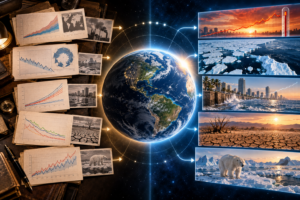
Climate information rarely travels directly from a scientific paper to the public.
More often, the chain looks something like this:
SCIENTIFIC PAPER
↓
UNIVERSITY / INSTITUTIONAL PRESS RELEASE
↓
NEWS AGENCY
↓
NEWSPAPER / TELEVISION / WEBSITE
↓
HEADLINE
↓
SOCIAL MEDIA
↓
PUBLIC MEMORY
Every step compresses information.
And compression creates opportunities for meaning to change.
A 10,000-word scientific paper cannot fit inside a 700-word newspaper story.
A 700-word story cannot fit inside a headline.
A headline cannot fit inside every social-media post.
Something has to disappear.
The important question is:
What?
Start With “Could”
Consider this sentence:
“Under scenario A, summer sea ice could decline below threshold X before 2050.”
The word could matters.
It describes possibility.
The scenario matters.
It defines the conditions.
The threshold matters.
It defines what scientists are measuring.
The date matters.
It defines when the claim can be tested.
Remove any one of those components and the meaning begins to change.
Now simplify it:
“Arctic sea ice could disappear before 2050.”
We have already lost the scenario and the threshold.
Simplify it again:
“Scientists warn Arctic sea ice will disappear by 2050.”
Now could has become will.
The conditional statement has become categorical.
And the object itself has changed from falling below a defined scientific threshold to simply “disappearing.”
The number may be identical.
The claim is not.
One Word Can Change the Prediction
Compare:
COULD HAPPEN
IS LIKELY TO HAPPEN
IS EXPECTED TO HAPPEN
WILL HAPPEN
Those phrases do not express the same degree of certainty.
Yet when historical climate predictions are collected decades later, they are frequently discussed as though they do.
That is dangerous because the verb is part of the forecast.
If a scientist assigns an event a 60% probability, the remaining 40% does not disappear because a headline needs to be short.
Likewise, if a scientist says an event will occur by a specific date, that categorical wording should not later be softened into “could.”
The rule has to work both ways.
Numbers Survive Better Than Qualifiers
There is another reason this happens.
Numbers are memorable.
Qualifiers are not.
Consider:
“There is a possibility of up to 50 million environmentally displaced people under worsening environmental conditions.”
What survives?
50 MILLION
Or:
“Yields from rain-fed agriculture could be reduced by up to 50% in some countries.”
What survives?
50%
This is precisely what happened with one of the cases we have already audited.
The IPCC's 2007 Africa statement concerned:
some countries
rain-fed agriculture
could
up to 50%
by 2020
Remove four of those elements and the statement can become:
“Africa's food production will fall 50% by 2020.”
That is not simplification.
It is a materially different claim.
“Some Countries” Becomes “Africa”
Geography is particularly vulnerable to headline compression.
A study may concern:
one glacier,
one coastline,
one polar-bear subpopulation,
one agricultural region,
or several selected countries.
The public version can become:
THE ARCTIC
AFRICA
POLAR BEARS
THE MALDIVES
THE WORLD
The geographical expansion makes the story simpler.
It also makes the claim broader.
Our polar-bear article demonstrated exactly why this matters.
A projection concerning Western Hudson Bay cannot automatically become a prediction concerning every polar bear on Earth.
ONE SUBPOPULATION ≠ GLOBAL SPECIES
The same rule applies to crops, glaciers, forests and coastlines.
“Up to” Creates the Perfect Headline Number
Suppose a report contains this range:
10%–50%
Which number makes the headline?
Usually not 10%.
The largest number has greater news value.
So:
“Losses could range from 10% to 50%”
can become:
“Losses Could Reach 50%.”
That headline may still be technically defensible.
But something interesting happens afterward.
The article is shortened again.
A television presenter summarizes it.
Someone posts it online.
Years later it is quoted from memory.
And:
COULD REACH 50%
becomes:
50% LOSS PREDICTED.
Then:
SCIENTISTS PREDICTED A 50% LOSS.
The upper boundary of a range has become the central forecast.
This Is Not Unique to Climate Science
The mechanism is not specifically climatic.
It occurs in medicine.
Economics.
Epidemiology.
Nutrition.
Crime statistics.
Election polling.
Any field involving probability and uncertainty faces the same problem.
Scientific language is designed to preserve uncertainty.
Headlines are designed to communicate quickly.
Those objectives can conflict.
Research on news communication has even found that different ways of expressing uncertainty affect how readers perceive information, while numerical ranges can communicate uncertainty effectively without necessarily destroying trust.
The communication problem is therefore real.
But it is not insoluble.
Headlines Matter
Headlines are not merely decoration.
For many people, the headline is the story.
They may never read the article.
Research on epistemic language in headlines shows that subtle linguistic choices can alter how readers perceive the truth and objectivity of the underlying claim.
That makes verbs particularly important.
Compare:
Scientists find...
Scientists suggest...
Scientists believe...
Scientists warn...
Scientists predict...
Each phrase frames the information differently before the reader encounters any evidence.
And climate stories frequently contain another powerful verb:
WARN.
A warning is not inherently inaccurate.
But it frames the information around risk.
That matters when the original scientific work explored multiple possible outcomes.
Scientists Are Part of the Chain Too
It would be too easy to blame everything on journalists.
Scientists communicate with journalists.
Universities issue press releases.
Research institutions promote findings.
Scientific journals publicize selected papers.
Authors give interviews.
And researchers themselves sometimes use vivid language to explain why their work matters.
So the chain is not:
CAREFUL SCIENTIST → RECKLESS JOURNALIST
Reality is more complicated.
A dramatic sentence can originate in:
the paper,
the abstract,
the press release,
the interview,
the journalist,
the headline writer,
or later commentary.
Sometimes the newspaper is more cautious than the scientist.
Sometimes the scientist is more cautious than the headline.
The only reliable way to know is to trace the statement backward.
The Original Source Is the Anchor
Suppose we discover a 1990 newspaper article saying:
“Scientists predict X by 2020.”
Our audit should not stop there.
We ask:
Who were the scientists?
What study was being discussed?
Can we find the original paper?
What did the paper actually say?
Was the date in the paper?
Was the number in the paper?
Was it a central estimate?
An upper bound?
A scenario?
A quotation from one researcher?
Or did the newspaper construct the claim from several different pieces of information?
This process often changes the verdict.
Sometimes the newspaper accurately preserved the scientific claim.
Sometimes it did not.
The 1970s Cooling Story Shows Why This Matters
Our article on 1970s global cooling demonstrated an extreme version of this problem.
Cooling research genuinely existed.
Scientists genuinely debated aerosol cooling.
Some researchers genuinely contemplated continued cooling.
And major media outlets published dramatic stories about the consequences.
But a later systematic review of the scientific literature found that papers anticipating warming substantially outnumbered papers anticipating cooling.
The memorable media narrative and the balance of the scientific literature were not identical.
A headline can therefore be historically real while still being unrepresentative of the scientific field.
That distinction is essential.
The Snowfall Headline Is an Almost Perfect Case
In March 2000, The Independent published the famous headline:
“Snowfalls Are Now Just a Thing of the Past.”
That sentence became one of the most frequently remembered British climate predictions.
But it was the newspaper's headline.
The scientist quoted in the article, David Viner, used different wording.
He said that within a few years winter snowfall would become a very rare and exciting event and suggested that children would not know what snow was.
That statement was still strong.
It remains auditable.
But:
HEADLINE ≠ QUOTATION
The distinction does not make the underlying forecast disappear.
It simply tells us who said what.
That is exactly what an evidence audit is supposed to preserve.
The Arctic Shows the Next Stage
The Arctic provides another example.
A scientist may discuss:
nearly ice-free
The scientific community may operationalize that as:
less than 1 million km² of September sea-ice extent
A newspaper may report:
ice-free Arctic
The public remembers:
no ice in the Arctic
Those are three different statements.
Again, the underlying concern is real.
Arctic sea ice has undergone a major long-term decline.
But if we want to judge a specific dated prediction, the measurement has to survive the communication chain.
Otherwise we are testing a different statement from the one originally made.
Disaster Is Newsworthy
Journalism naturally selects what is unusual, consequential and important.
“Model produces modest change under middle scenario” is not a particularly compelling headline.
“Study warns of catastrophic change” is.
This does not require conspiracy.
It follows from ordinary news selection.
Research into climate journalism has repeatedly examined the roles of risk, disaster narratives, uncertainty, conflict and journalistic framing. One cross-national analysis found that uncertainty was widespread in climate coverage, while disaster narratives also appeared frequently.
More recent work on IPCC scenario coverage found that media outlets differed substantially in how often they explicitly retained the word scenario. In the sample examined, Reuters used the term more consistently than some other outlets.
So there is no single “media treatment.”
Different organizations preserve different amounts of scientific context.
Sometimes the Problem Goes the Other Way
There is another distortion worth mentioning.
Uncertainty can also be exaggerated.
A scientific assessment may establish something with high confidence.
News coverage can present two opposing views as though the evidence were evenly divided.
This became known as the problem of false balance.
Research into climate journalism has documented how traditional norms of presenting “both sides” sometimes gave disproportionate visibility to positions that did not reflect the balance of scientific evidence.
So media transformation does not always make climate claims more certain.
Sometimes it makes established findings appear less certain.
That is why our method cannot assume the direction of distortion.
We have to measure it.
There Are Two Opposite Errors
ERROR 1 — AMPLIFICATION
could → will
range → maximum
local → global
conditional → unconditional
possible → inevitable
ERROR 2 — DILUTION
high confidence → disputed
strong evidence → one side says
scientific consensus → controversy
observed trend → merely possible
Both distort the original evidence.
Our audit should accept neither.
Social Media Adds Another Compression Layer
Now add social media.
A newspaper article may still contain:
the scenario,
the caveats,
the source,
the uncertainty,
and the actual quotation.
But the social-media post contains:
a screenshot of the headline.
Nothing else.
Then somebody reposts the screenshot ten years later.
The publication date disappears.
Then the context disappears.
Eventually the screenshot becomes evidence of what:
“science said.”
But it may actually document only what:
one headline writer said about one study on one day.
That is not useless evidence.
It simply answers a different question.
A Headline Is Evidence — Of the Headline
This deserves its own rule.
If Newsweek published a cooling headline in 1975, that proves the headline existed.
It does not by itself prove that climate science had reached a cooling consensus.
If a newspaper said snow would disappear, that proves the newspaper presented the claim that way.
It does not automatically establish the exact wording of the scientific source.
If a scientist made the same claim directly, however, then the scientist owns that claim.
The evidence must be attributed to the correct person.
NEWSPAPER CLAIM ≠ SCIENTIFIC CONSENSUS
But also:
SCIENTIST'S PUBLIC CLAIM ≠ NEWSPAPER INVENTION
Attribution solves much of the confusion.
The Headline Test
For every dramatic historical climate headline, try this:
1. FIND THE HEADLINE
Preserve it exactly.
2. READ THE ARTICLE
Does the body say the same thing?
3. FIND THE QUOTATION
What did the scientist actually say?
4. FIND THE ORIGINAL STUDY
Does the paper contain the same number and deadline?
5. RESTORE THE QUALIFIERS
Could?
Likely?
Up to?
Under scenario X?
If current trends continue?
6. IDENTIFY THE METRIC
Extinction?
Decline?
Extent?
Volume?
Yield?
Production?
7. WAIT FOR THE DEADLINE
Only then can the claim receive a final verdict.
This turns a headline into an auditable chain of evidence.
What Should Count as the Prediction?
Sometimes there will be more than one legitimate answer.
Imagine:
A paper says could.
The scientist says likely in an interview.
The university press release says expected.
The newspaper says will.
Which one is the prediction?
All four statements belong in the historical record.
But they should not be merged.
The correct audit records them separately:
SCIENTIFIC PAPER — CLAIM A
SCIENTIST INTERVIEW — CLAIM B
PRESS RELEASE — CLAIM C
MEDIA HEADLINE — CLAIM D
Then each statement can be attributed and evaluated on its own terms.
That is far more informative than asking whether “the scientists” were right.
Why This Matters for 100 Predictions
This is precisely why a list of historical climate predictions cannot simply be a collection of screenshots.
A screenshot may be the beginning of the investigation.
It cannot always be the end.
For every prediction in this project, the objective is to reconstruct:
WHO SAID IT
WHAT THEY SAID
WHEN THEY SAID IT
WHAT CONDITIONS THEY ATTACHED
WHAT DEADLINE THEY GAVE
WHAT HAPPENED
Only then does the verdict mean anything.
THE VERDICT
Does “could” sometimes become “will” on the way to the headline?
Yes.
But that is not a universal rule of climate journalism.
Research shows that uncertainty language remains common in climate reporting, and different media organizations preserve scenarios and qualifications to different degrees.
The deeper problem is information compression.
Every stage can alter the claim:
SCIENTIFIC PAPER
→ PRESS RELEASE
→ NEWS STORY
→ HEADLINE
→ SOCIAL MEDIA
→ PUBLIC MEMORY
During that journey:
COULD CAN BECOME WILL.
UP TO CAN BECOME EXPECTED.
LOCAL CAN BECOME GLOBAL.
A SCENARIO CAN BECOME A FORECAST.
But the opposite can happen too:
HIGH CONFIDENCE CAN BECOME CONTROVERSY.
Therefore the headline cannot automatically be treated as the scientific prediction.
Nor can the scientific paper automatically excuse a stronger public statement made by its author.
THE RULE IS SIMPLE:
ATTRIBUTE EACH CLAIM TO THE PERSON OR INSTITUTION THAT ACTUALLY MADE IT.
Then trace it backward.
Restore the missing words.
Restore the range.
Restore the geography.
Restore the probability.
Restore the scenario.
Restore the deadline.
Because sometimes the most important difference between a prediction that failed and a projection that did not...
is a single word.
COULD.
From the Book
This article is part of the evidence-audit methodology behind Patrick Panteix's CLIMATE: THE PREDICTIONS THAT EXPIRED — What We Were Told. What Actually Happened. Who Profited.
The principle is simple:
Don't audit the memory of the prediction.
Audit the original prediction.
100 predictions. 100 verdicts.
SOURCES
IPCC — AR6 Working Group II, Annex II: Glossary
Official IPCC definitions of scenario, projection, likelihood and other terms used to communicate future climate outcomes.
https://www.ipcc.ch/report/ar6/wg2/chapter/annex-ii/
IPCC — Guidance Note for Lead Authors on Consistent Treatment of Uncertainties
Official guidance describing the calibrated language used by IPCC authors to communicate confidence and likelihood.
https://www.ipcc.ch/site/assets/uploads/2017/08/AR5_Uncertainty_Guidance_Note.pdf
Painter, James — Climate Change in the Media: Reporting Risk and Uncertainty
Reuters Institute for the Study of Journalism / University of Oxford.
Research examining how uncertainty, risk and disaster narratives are communicated in climate reporting.
https://reutersinstitute.politics.ox.ac.uk/our-research/climate-change-media-reporting-risk-and-uncertainty
Climatic Change — Communicating Climate Futures: A Multi-Country Study of How the Media Portray the IPCC Scenarios in the 2021/2 Working Group Reports (2024)
Cross-national analysis examining how news organizations communicated IPCC scenarios, including differences in whether terms such as “scenario” and likelihood language were preserved.
https://link.springer.com/article/10.1007/s10584-024-03744-z
Frontiers in Communication — Framing Climate Change: Economics, Ideology, and Uncertainty in American News Media Content From 1988 to 2014 (2019)
Study examining changes in uncertainty framing and climate-science representation in American news coverage.
https://www.frontiersin.org/journals/communication/articles/10.3389/fcomm.2019.00006/full
Global Environmental Change — Beyond False Balance: How Interpretive Journalism Shapes Media Coverage of Climate Change (2017)
Cross-national study examining journalistic framing, scientific consensus and the treatment of contrarian voices in climate reporting.
https://doi.org/10.1016/j.gloenvcha.2016.11.004
Proceedings of the National Academy of Sciences — Communicating Uncertainty About Facts, Numbers and Science
Experimental research showing how different ways of communicating uncertainty, including numerical ranges and verbal qualifications, affect readers.
https://www.pnas.org/doi/10.1073/pnas.1913678117
Scientific Reports — Epistemic Language in News Headlines Shapes Readers’ Perceptions of Objectivity (2024)
Experimental research showing that linguistic choices in headlines can affect readers’ perceptions of truth and objectivity, including in climate-related examples.
https://pmc.ncbi.nlm.nih.gov/articles/PMC11098081/