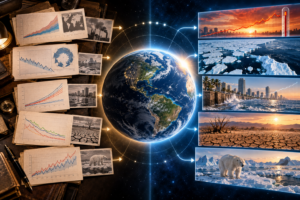

Climate predictions are easy to remember before the deadline.
The Arctic will be ice-free.
The glaciers will disappear.
The islands will be underwater.
Food production will collapse.
Species will vanish.
Millions of people will become environmental refugees.
Then the deadline arrives.
And something strange often happens.
The prediction disappears from the conversation.
The date is forgotten.
The wording changes.
The original source becomes difficult to find.
Or a completely different argument takes its place:
“But the underlying trend was real.”
Sometimes it was.
That is not the same question.
The purpose of an evidence audit is not to ask whether climate change exists.
It is not to decide whether environmental protection is good or bad.
It is not to determine whether every climate model works.
It asks something much narrower:
WHAT WAS PREDICTED?
BY WHEN?
UNDER WHAT CONDITIONS?
AND WHAT ACTUALLY HAPPENED WHEN THE DEADLINE ARRIVED?
That is the test behind CLIMATE: THE PREDICTIONS THAT EXPIRED.
And after examining one hundred cases, one conclusion becomes unavoidable:
the historical record is much more complicated than either side of the climate debate usually admits.
First: What Does “100 Predictions” Mean?
This distinction is essential.
The book contains a broad audit of 100 climate and environmental prediction cases.
Those cases are not automatically failures.
Each claim is examined first and receives the verdict supported by the evidence.
The possible verdicts include:
CONFIRMED
PARTIALLY CONFIRMED
FAILED
DEADLINE MISSED
EXAGGERATED
MISQUOTED
CONDITIONAL
STILL OPEN
Only after that broader audit does the book apply a much stricter filter.
A separate section — THE 100 THAT FAILED — contains exactly 100 source-checked predictions whose deadlines expired and whose stated outcomes did not occur as predicted.
Why separate them?
Because otherwise the conclusion would determine the evidence.
The method has to work the other way around:
THE AUDIT CHOOSES THE VERDICT.
THE VERDICT DOES NOT CHOOSE THE AUDIT.
The First Rule: Find the Original Claim
A prediction cannot be audited from memory.
Suppose somebody remembers:
“Scientists said Africa's food production would fall by 50% by 2020.”
That sounds testable.
But the original IPCC wording was substantially narrower.
It concerned rain-fed agricultural yields in some countries, which could be reduced by up to 50% by 2020.
Those qualifiers change the claim.
Likewise:
“Polar bears were supposed to be extinct by 2020.”
Which polar bears?
The entire species?
A regional population?
Was extinction predicted?
Or decline?
Was the date categorical?
Or conditional?
Every word matters.
That produces the first rule of the audit:
DO NOT AUDIT THE VERSION PEOPLE REMEMBER.
AUDIT THE VERSION THAT WAS ACTUALLY SAID.
The book's methodology therefore begins with five elements:
ORIGINAL SOURCE → DATE → DEADLINE → OBSERVED RESULT → VERDICT.
The Second Rule: A Deadline Has to Expire
A prediction for 2100 cannot be declared wrong in 2026.
It cannot be declared right either.
The deadline has not arrived.
This sounds obvious.
It is surprisingly easy to violate.
A model may be tracking observations well today and still diverge later.
Another projection may currently appear too high or too low and eventually converge.
So the rule is:
NO EXPIRED DEADLINE = NO FINAL VERDICT.
We can examine the trajectory.
We can examine the assumptions.
We can examine whether observations are moving toward the projected range.
But we cannot pretend to possess observations from 2100.
The clock matters.
The Third Rule: Direction and Deadline Are Different Bets
This is perhaps the most important result of the entire audit.
A phenomenon can be real while a prediction about that phenomenon fails.
Consider Arctic sea ice.
The long-term decline is unmistakable.
The book's underlying evidence notes that the lowest annual Arctic sea-ice minima in the satellite record are concentrated in the modern period.
But some specific predictions of an essentially ice-free summer Arctic attached that decline to dates that have already passed.
Summer sea ice remained.
Both statements can therefore be true:
ARCTIC SEA ICE DECLINED DRAMATICALLY.
and
SOME ICE-FREE-ARCTIC DEADLINES FAILED.
There is no contradiction.
One statement tests direction.
The other tests timing.
Glaciers Tell the Same Story
Kilimanjaro lost enormous amounts of ice.
Quelccaya retreated substantially.
Glacier National Park's glaciers became smaller.
The Rwenzori glaciers suffered severe losses.
These are observable physical changes.
But disappearance is a different measurement from retreat.
A glacier can lose:
10%,
30%,
50%,
even 90% of its area,
and still not have disappeared.
So when a prediction says:
GONE BY 2020
the test at the deadline is not:
DID THE GLACIER RETREAT?
It is:
WAS IT GONE?
The book's final audit records, for example, Quelccaya's 2010–2020 disappearance timetable as missed because the ice cap remained after 2020, while explicitly retaining the fact that substantial retreat occurred.
The Rwenzori case is even more instructive: the manuscript records glacier loss exceeding 90%, yet surviving remnants were still documented after the forecast horizon.
Again:
RETREAT ≠ DISAPPEARANCE
The Maldives Show Why Consequences Must Be Tested Separately
Sea level is rising.
That is measured.
The Maldives are low-lying.
That is measurable too.
The islands face genuine long-term exposure to sea-level rise.
But those facts do not automatically validate every historical prediction made about the Maldives.
A 1988 report warned that the islands could be completely covered within thirty years.
That takes us to approximately 2018.
The Maldives were not completely covered.
The book therefore records the deadline as failed.
That verdict does not mean:
SEA-LEVEL RISE IS FALSE.
It means:
COMPLETE COVERAGE DID NOT OCCUR BY THE STATED DEADLINE.
That distinction is the entire point of the audit.
Snow Can Decline Without Disappearing
The famous British snowfall case demonstrates another version of the same problem.
In 2000, The Independent published:
“Snowfalls Are Now Just a Thing of the Past.”
The scientist quoted in the article, David Viner, predicted that snowfall would become a very rare and exciting event within a few years and suggested that children would no longer know what snow was.
The following decades did not produce snowless Britain.
The book therefore records the near-term deadline as failed.
That does not require proving that British winters have not warmed.
It does not require proving that snow patterns never changed.
It tests the forecast that was actually made.
Extinction Predictions Require an Even Stricter Test
Species predictions create another problem:
DECLINE ≠ EXTINCTION
A population can decline severely and remain extant.
Habitat can shrink.
Conservation status can deteriorate.
Mortality can increase.
All of those may be serious.
But if the prediction is:
EXTINCT BY YEAR X
then extinction is the endpoint being tested.
The book's final failed-prediction archive includes numerous historical species-loss and extinction forecasts where the advertised endpoint did not occur by the stated deadline.
For example, a roughly decade-long orangutan wild-extinction warning expired while orangutans remained in the wild.
Likewise, historical projections of enormous global species losses by 2000 did not match the documented extinction record at the deadline, while the book explicitly preserves uncertainty about unrecorded extinctions and the reality of biodiversity loss.
A serious environmental problem does not need an exaggerated deadline to remain serious.
Agriculture Shows Why Metrics Matter
One of the easiest mistakes in prediction auditing is comparing two different measurements.
Consider:
YIELD
PRODUCTION
FOOD SUPPLY
FOOD AVAILABILITY
HUNGER
FAMINE
These are related.
They are not interchangeable.
A lower crop yield does not automatically mean famine.
A country can compensate through acreage, irrigation, crop substitution, imports, stocks, technology or changes in consumption.
Likewise, a country can experience hunger even when enough food exists nationally because people cannot afford or access it.
So:
LOWER YIELD ≠ CROP FAILURE ≠ FOOD SHORTAGE ≠ HUNGER ≠ FAMINE
The Population Bomb provides the classic example.
Population increased dramatically.
That part of the underlying concern was real.
But the anticipated near-term global mass-famine outcome did not occur on the predicted scale.
Global agricultural production changed too.
The Green Revolution changed yields.
Technology changed.
Trade changed.
The future did not remain frozen at the assumptions of the late 1960s.
The manuscript therefore classifies the famous near-term mass-famine forecast as expired while explicitly preserving the reality of population pressure, poverty and hunger.
Some Predictions Were Actually Good
This is where the audit becomes more interesting.
A book about failed predictions would be misleading if it implied that climate science predicted nothing correctly.
Some forecasts performed surprisingly well.
Historical global-temperature projections provide a strong example.
Retrospective scientific analyses have compared old model projections with subsequent observations.
Some models ran warmer than observations.
Some cooler.
But many performed well, particularly when differences between projected and actual climate forcing were taken into account.
The book therefore rejects the blanket claim:
“CLIMATE MODELS ALWAYS RUN HOT.”
Its review of the historical literature notes that the evaluated models did not show a systematic tendency to overestimate or underestimate warming once forcing differences were considered.
The broad audit also gives credit to several successful or substantially successful predictions:
global warming trends,
ocean heat accumulation,
long-term mean sea-level rise,
Southwestern U.S. aridification,
and the long-term decline of Arctic summer sea ice.
This matters.
Because:
A FAILED GLACIER DEADLINE DOES NOT INVALIDATE A SUCCESSFUL TEMPERATURE PROJECTION.
And:
A SUCCESSFUL TEMPERATURE PROJECTION DOES NOT RESCUE A FAILED GLACIER DEADLINE.
Each prediction gets its own evidence.
Skeptics Made Failed Predictions Too
The same rule must apply to people who reject or criticize mainstream climate projections.
Climate skeptics have made predictions.
Some forecast cooling.
Some predicted that warming had stopped.
Some predicted Arctic sea ice would recover.
Some claimed climate models systematically overestimated warming.
Those statements are testable too.
The book explicitly applies the same method regardless of whether a prediction came from a government agency, university, environmental organization, climate skeptic or Nobel laureate.
That produces another fundamental rule:
ALARMIST ≠ WRONG
SKEPTIC ≠ RIGHT
SCIENTIST ≠ INFALLIBLE
CONTRARIAN ≠ FOOL
Identity is not evidence.
Observation is.
The 1998 Warming Claim Is a Good Example
After the exceptionally warm 1998 El Niño year, claims that global warming had stopped became widespread.
There was a legitimate observational fact behind the discussion:
surface warming over certain short intervals slowed.
But three statements were often confused:
warming slowed
warming stopped
cooling began
The first describes a short-term rate.
The second makes a much stronger claim.
The third is a prediction.
Subsequent temperature observations did not support the strongest versions of the argument. The manuscript records 2015–2025 as the eleven warmest years in the Berkeley Earth instrumental record used in the audit and treats a permanent end to warming around 1998 as failed.
The lesson is symmetrical.
A real short-term observation can become a bad long-term prediction when extrapolated too far.
Why Predictions Fail
There is no single explanation.
A failed prediction does not automatically mean fraud.
It can fail because:
the model was wrong,
the input assumptions were wrong,
the trend changed,
technology changed,
policy changed,
adaptation occurred,
natural variability intervened,
a conditional projection was presented as unconditional,
an upper range became the expected outcome,
a journalist broadened the geography,
a scientist overstated the certainty,
or a headline attached a date that the underlying research did not justify.
The manuscript makes this distinction explicit: a bad prediction can arise from an honest model, a wrong assumption, an extreme scenario, a communication failure, or a headline that removed the conditions.
Therefore:
FAILED ≠ FRAUD
That is an important limit.
But “The Trend Was Real” Is Not a Universal Defense
The opposite mistake is equally serious.
Suppose somebody predicts:
Glacier X will disappear by 2020.
2020 arrives.
The glacier has lost 60% of its area.
The prediction failed.
Saying:
“Yes, but the glacier shrank.”
does not change the deadline.
The shrinkage validates the direction.
It does not validate the endpoint.
The manuscript states this rule particularly clearly:
A REAL TREND DOES NOT RESCUE A FAILED PREDICTION.
And:
A FAILED PREDICTION DOES NOT PROVE THAT THE UNDERLYING TREND WAS FALSE.
Both principles have to survive.
Otherwise the audit becomes advocacy.
What the 100 Cases Actually Teach Us
The most important finding is not a percentage.
It is methodological.
Predictions contain several independent components:
DIRECTION
What goes up or down?
MAGNITUDE
By how much?
TIMING
By when?
GEOGRAPHY
Where?
METRIC
What exactly is being measured?
CONDITIONS
Under what assumptions?
A prediction can get some of these right and others wrong.
For example:
DIRECTION: RIGHT
MAGNITUDE: WRONG
TIMING: WRONG
That is not simply “right” or “wrong.”
Or:
TREND: RIGHT
DISAPPEARANCE DEADLINE: WRONG
Or:
GLOBAL TEMPERATURE RESPONSE: BROADLY RIGHT
ASSUMED FUTURE EMISSIONS: DIFFERENT FROM REALITY
That is why the broad audit needs multiple verdict categories.
Reality is rarely binary.
The Most Dangerous Word in Prediction Auditing
There is one word that causes enormous trouble:
THEY
“They predicted...”
Who?
A scientist?
A newspaper?
An environmental organization?
A government agency?
The IPCC?
A politician?
A university press office?
One researcher during an interview?
A peer-reviewed paper?
A headline writer?
There is no meaningful category called simply:
THEY.
The source has to be named.
Otherwise one person's failed prediction can become “what science predicted.”
And one successful scientific model can become proof that every dramatic public warning was justified.
Neither conclusion follows.
So Did Climate Predictions Fail?
Some did.
Some did not.
Some got the trend right but the date wrong.
Some were conditional.
Some were exaggerated in transmission.
Some were never predictions in the first place.
Some remain open because their deadlines are decades away.
And some performed remarkably well.
That is exactly why the audit matters.
The manuscript itself summarizes the result without pretending that failed deadlines mean nothing happened: the planet warmed, seas rose, Arctic ice declined, glaciers retreated, ecosystems experienced genuine stress — while many prominent expired deadlines examined in the selected corpus still failed.
Both sides of that sentence matter.
THE VERDICT
After one hundred cases, the evidence does not support either of the two simplest slogans.
Not:
“CLIMATE SCIENCE WAS ALWAYS WRONG.”
And not:
“THE PREDICTIONS WERE BASICALLY ALL RIGHT.”
The record is more demanding.
Some projections worked.
Some deadlines failed.
Some trends were correctly identified.
Some magnitudes were exaggerated.
Some scenarios were mistaken for forecasts.
Some headlines went beyond their sources.
Some scientists themselves went too far.
Some skeptics made predictions that observations later rejected.
And some future projections cannot yet be judged at all.
The only defensible method is therefore the least exciting one:
FIND THE ORIGINAL SOURCE.
PRESERVE THE WORDING.
PRESERVE THE CONDITIONS.
IDENTIFY THE METRIC.
WAIT FOR THE DEADLINE.
COMPARE IT WITH OBSERVATION.
THEN ASSIGN THE VERDICT.
Because the question is not:
WHO DO YOU TRUST?
The question is:
WHAT DID THEY PREDICT — AND WHAT ACTUALLY HAPPENED?
From the Book
This article presents the methodology behind Patrick Panteix's CLIMATE: THE PREDICTIONS THAT EXPIRED — What We Were Told. What Actually Happened. Who Profited.
The book contains a broad audit in which predictions can succeed, fail, remain conditional or remain open.
It also contains a separate, stricter archive:
THE 100 THAT FAILED.
Exactly one hundred source-checked predictions.
Exactly one hundred expired deadlines.
And one rule applied throughout:
THE AUDIT CUTS BOTH WAYS.
SOURCES
IPCC — Climate Change 2021: The Physical Science Basis
The IPCC Sixth Assessment Report provides the modern scientific baseline for observed warming, sea-level rise, cryosphere change and the distinction between observations, projections and scenarios.
https://www.ipcc.ch/report/ar6/wg1/
IPCC — AR6 Working Group I, Summary for Policymakers
Summary of observed global warming, sea-level rise and other major changes in the climate system.
https://www.ipcc.ch/report/ar6/wg1/chapter/summary-for-policymakers/
National Snow and Ice Data Center (NSIDC) — Sea Ice Index
Satellite-based observational record used to compare historical Arctic sea-ice predictions with subsequent sea-ice extent.
https://nsidc.org/data/seaice_index
U.S. National Park Service — Glacier National Park: Glaciers Overview
Official NPS account of glacier retreat and the history of the public 2020/2030 glacier-disappearance estimates.
https://www.nps.gov/glac/learn/nature/glaciersoverview.htm
NOAA — Climate at a Glance
Long-term observational temperature records used to test historical warming and cooling claims.
https://www.ncei.noaa.gov/access/monitoring/climate-at-a-glance/
NASA — Global Climate Change: Sea Level
Satellite and observational evidence documenting the long-term rise in global mean sea level.
https://science.nasa.gov/earth/climate-change/vital-signs/sea-level/
IUCN/SSC Polar Bear Specialist Group — Population Status
Scientific assessments of recognized polar-bear subpopulations, abundance estimates and population trends.
https://www.iucn-pbsg.org/population-status/
Hausfather, Z.; Drake, H.F.; Abbott, T.; Schmidt, G.A. — “Evaluating the Performance of Past Climate Model Projections” (Geophysical Research Letters, 2020)
Retrospective evaluation of global-temperature model projections published between 1970 and 2007, including comparisons adjusted for differences between projected and realized forcing.
https://doi.org/10.1029/2019GL085378
Berkeley Earth — Global Temperature Report
Independent observational global-temperature record used to evaluate historical warming, cooling and “warming stopped” claims.
https://berkeleyearth.org/global-temperature-report/
Patrick Panteix — CLIMATE: THE PREDICTIONS THAT EXPIRED
The full book applies the source → deadline → observation → verdict method across the complete audit corpus and the separate final archive of 100 expired predictions.