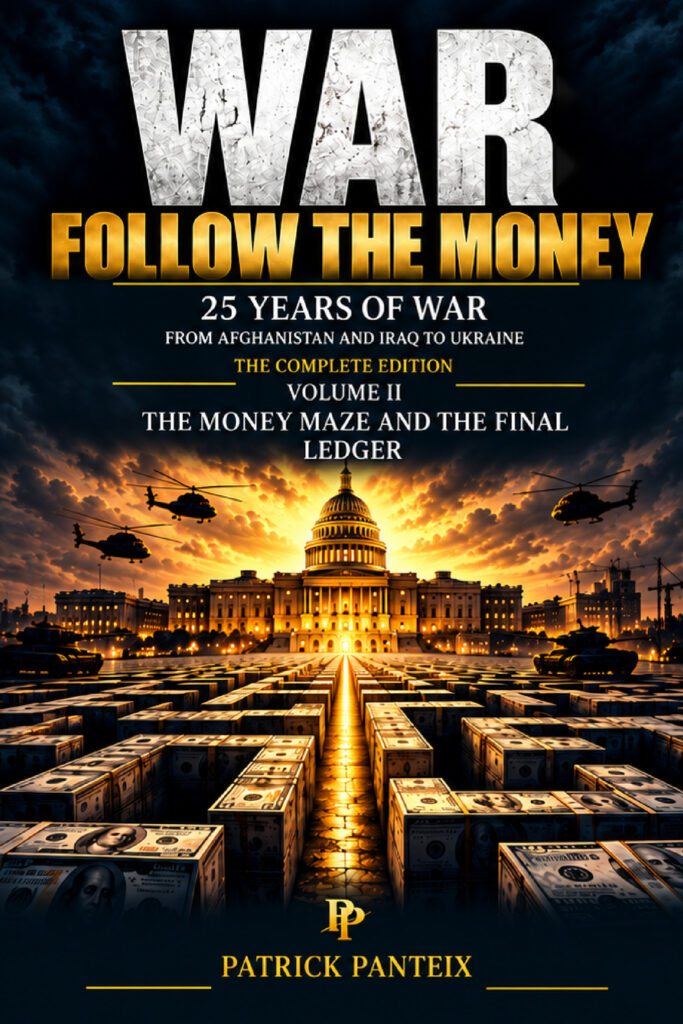
Patrick Panteix
← RETOUR AUX LIVRES

WAR FOLLOW THE MONEY – VOLUME II

25 YEARS OF WAR — FROM AFGHANISTAN AND IRAQ TO UKRAINE

United States
The battlefield is only the beginning of the story.

In Volume II of WAR FOLLOW THE MONEY, Patrick Panteix follows the financial machinery behind modern war: Ukraine funding, Pentagon contracts, defense contractors, weapons replenishment, lobbying, consultants, Wall Street, and the long-term costs that continue after the fighting.

From appropriations to obligations, from contracts to production, and from public spending to the final ledger, this volume follows the money where official headlines often stop.
DISPONIBLE SUR AMAZON
LE LIVRE

Présentation

For twenty-five years, America’s wars have consumed enormous sums of public money. But a headline number does not explain where the money actually went.

WAR FOLLOW THE MONEY — VOLUME II continues the investigation where Volume I ends.

Across Chapters 43–80, Patrick Panteix examines the financial machinery surrounding modern war: congressional appropriations, obligations, disbursements, contracts, weapons replenishment, Ukraine assistance, defense production, prime contractors, suppliers, lobbying, consultants, financial markets, and the costs that remain long after military operations end.

The purpose is not to turn every contract into an accusation or every financial relationship into a political conclusion. The investigation carefully separates what the public record actually proves.

An appropriation is not a payment.
An obligation is not a disbursement.
A contract award is not corporate revenue.
Revenue is not profit.
A weapons transfer is not necessarily a new cash payment.

Using Department of Defense records, GAO reports, inspector general audits, federal spending data, budget documents, corporate filings, and other public sources, the book reconstructs the financial chain step by step.

Who authorized the money?
Who obligated it?
Who received the contracts?
Where was the production carried out?
Which companies and institutions became part of the system?
And how much of the money trail can actually be documented?

Volume II carries the investigation through Ukraine, the defense industry, lobbying, Wall Street, the long-term fiscal burden of war, and finally the Final Ledger.

The result is a documentary investigation built around one rule: follow the evidence before following the conclusion.

THÈMES

Sujets principaux

  • U.S. war spending
  • Pentagon budget
  • defense contractors
  • military-industrial complex
  • Ukraine funding
  • defense procurement
  • weapons replenishment
  • lobbying
  • government contracts
  • war economy
  • military spending
  • post-9/11 wars
ENQUÊTE

Questions abordées

  • Where did America’s post-9/11 war money actually go?
  • How much Ukraine-related funding was appropriated, obligated, and disbursed?
  • Who received the major defense contracts?
  • How does U.S. weapons replenishment work after stockpiles are transferred?
  • Which defense companies benefited from new programs and production orders?
  • How does defense-industry lobbying operate in Washington?
  • What roles do consultants, think tanks, and former military officials play?
  • How should contract value, corporate revenue, and profit be distinguished?
  • Where does defense spending create economic activity inside the United States?
  • What role do Wall Street and major asset managers play in the defense economy?
  • Which war costs continue long after military operations end?
  • How much of the financial trail can be traced through public records?
  • Which figures cannot be added together without double counting?
  • What does the Final Ledger prove — and what remains unresolved?