Livre broché
Édition papier

Édition papier
Édition numérique
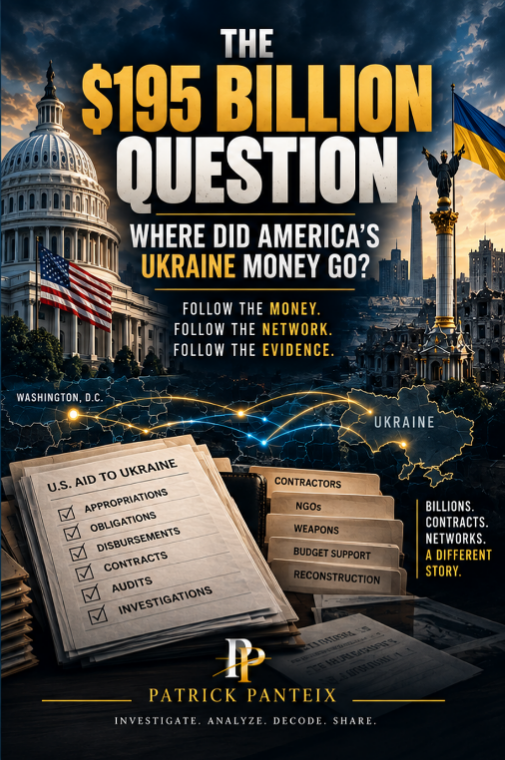
# THE $195 BILLION QUESTION
## WHERE DID AMERICA'S UKRAINE MONEY GO?
$195 billion.
That is approximately how much funding had been appropriated or otherwise made available for the U.S. response to Russia's full-scale invasion of Ukraine as of March 31, 2026.
But where did that money actually go?
How much reached Ukraine? How much remained inside the United States? How much financed American military operations, weapons manufacturers, stockpile replenishment, government programs, or international financial mechanisms?
And how much of the financial trail can the public independently verify?
These questions form the foundation of THE $195 BILLION QUESTION: WHERE DID AMERICA'S UKRAINE MONEY GO?, an investigative book by Patrick Panteix.
### FOLLOW THE MONEY. EXAMINE THE EVIDENCE.
Since February 2022, the United States has mobilized enormous financial resources in response to the war in Ukraine.
Congressional appropriations, military assistance programs, defense contracts, economic support, humanitarian funding, and international financial arrangements have created a complex system of public spending.
Yet the numbers reported in political speeches, news coverage, and government documents do not always describe the same financial reality.
Money appropriated by Congress is not necessarily money spent.
Money obligated under a government program is not necessarily money disbursed.
And money spent in support of Ukraine is not necessarily money transferred to the Ukrainian government.
Understanding these distinctions is essential to understanding the true financial dimensions of America's response to the war.
### AN INVESTIGATION BUILT ON DOCUMENTS
Patrick Panteix examines the public financial record through government audits, congressional documents, oversight reports, federal spending data, defense procurement information, and international institutional records.
Rather than relying on political declarations alone, the investigation reconstructs how money was authorized, allocated, obligated, disbursed, and monitored.
It examines the institutions responsible for administering public funds and the financial mechanisms through which resources were mobilized.
The investigation also addresses documented oversight weaknesses, audit findings, accountability questions, and publicly reported corruption investigations, while distinguishing proven facts from allegations and unresolved questions.
### INSIDE THE INVESTIGATION
The book explores several central questions.
THE $195 BILLION FIGURE
What does the headline total actually include? Which financial categories make up the figure, and why is it misleading to treat every dollar as direct aid delivered to Ukraine?
THE AMERICAN DEFENSE INDUSTRY
How do military assistance, weapons procurement, ammunition production, equipment replacement, and U.S. defense contracts fit into the financial picture?
DIRECT BUDGET SUPPORT
How did American financial support for Ukrainian government functions operate? Which institutions administered the funds, and what oversight mechanisms were established?
THE INTERNATIONAL FINANCIAL SYSTEM
What roles did the World Bank, international financial arrangements, and other institutions play in supporting Ukraine?
AUDITS, OVERSIGHT, AND ACCOUNTABILITY
What did inspectors general and government auditors examine? What weaknesses were identified, and what questions remain open?
THE FINANCIAL TRAIL
Which financial flows can be documented through publicly available records, and where do reporting gaps make independent verification more difficult?
### NOT A BOOK ABOUT WHO SHOULD WIN THE WAR
This investigation does not ask readers to abandon their political convictions or choose a position on the conflict.
It asks a different question:
When governments mobilize extraordinary amounts of public money, how can citizens determine where that money went?
The book separates financial facts from political interpretation, documented oversight findings from allegations of misconduct, and verified transactions from incomplete reporting.
A funding gap is not automatically evidence of theft. An audit weakness is not proof of corruption. And a government appropriation is not equivalent to a completed payment.
These distinctions are fundamental to following the money responsibly.
### A QUESTION EVERY AMERICAN TAXPAYER HAS THE RIGHT TO ASK
THE $195 BILLION QUESTION invites readers to look beyond headlines and examine the financial mechanisms behind one of the most consequential international responses of the twenty-first century.
Through documentary investigation and financial analysis, Patrick Panteix explores how public money moves through government agencies, contractors, military programs, and international institutions.
The objective is not to tell readers what to think.
It is to give them a clearer understanding of what can be established from the public record.
Because whatever Americans believe about the war, transparency and accountability remain essential.
**FOLLOW THE MONEY. FOLLOW THE RECORDS. FOLLOW THE EVIDENCE.**
This investigation is based on publicly available documentary evidence, including U.S. congressional appropriations, federal financial reports, government audits, inspectors general findings, defense procurement records, official oversight publications, and international institutional documents.
Principal research sources include:
- U.S. Congress and Congressional Research Service (CRS)
- U.S. Government Accountability Office (GAO)
- Special Inspector General for Operation Atlantic Resolve (SIG-OAR)
- U.S. Department of Defense and Department of State
- USAID Office of Inspector General
- U.S. Department of Justice (DOJ)
- World Bank and international financial institution reports
- Official federal procurement and spending records
- Publicly available court filings and institutional disclosures
The methodology distinguishes appropriations, obligations, disbursements, financial commitments, and actual transfers.
Documented transactions are distinguished from estimates. Audit findings are separated from allegations, and allegations are not presented as established wrongdoing.
Financial reporting limitations are identified where available records do not permit independent verification.
The investigation uses dated reference points to avoid combining financial totals from incompatible reporting periods.
Its objective is to reconstruct the financial trail using verifiable sources, without treating missing information as proof of misconduct.